
Written by Tomas Lima
With the recent prohibition of phone usage at school, students have not had access to their phones for about one third of their days for almost 2 months since the beginning of the semester. Differing opinions, controversies, and feelings have risen within the school community. How effective has it been? What impacts has it had? Has phone usage been properly prevented? These are all questions that linger within the thoughts of both students and staff. However, one question seems to stand above all: Why?
The simple and general response to this question that students usually receive is that the school is trying to protect us, doing this for our own good, and that perhaps students aren’t mature enough to understand it just yet. This response, aside from not properly answering the question, also paints students as naive, as well as raising another doubt: what exactly could the school be protecting us from? In order to answer this question, it is imperative to look into professional research and gathered data.
It is evident that the decision was backed by topics addressed in the book The Anxious Generation, by psychologist and professor Jonathan Haidt, where he argues that phone usage has been a leading factor in the worsening mental health of teenagers, as well as proposing solutions and actions that individuals, parents, institutions, and governments can take in order to aid in the prevention of the negative impacts of phones (More info on him here). For those interested, Dr. Maurício Gozzi has been uploading readings of this book to the EAC App. With that being established, what does the book truly show?
The Data
Haidt claims the “phone-based childhoods”, meaning not only phones but all other devices that surround children nowadays, truly began in the very early 2010s, when high speed internet was made widely available and smartphones began being properly developed and commercialized into what we have today, with a massive variety of apps, laying the foundation for what is referred to as an “epidemic of mental illness”. Haidt divides the problems caused by cellphones into “4 main harms”, which are: Social deprivation, sleep deprivation, attention fragmentation, and addiction.
Social Deprivation
It is no mystery, people have been spending more time on their phones and computers, talking through social media and spending time on games, rather than having a face-to-face conversation. Even when there is physical interaction, phones remove the quality of conversations, being such an attractive distraction. Think about it this way: has someone ever kept staring at their phones while talking to you? How did that feel? The reduction in social interaction through the use of phones is statistically visible.

The graph displays the amount of time people of varied age groups have spent with their friends, on a daily average of minutes. Coinciding with Haidt’s claim that the phone-based childhood started in the early 2010s, a very clear and drastic decrease in the time people spent with their friends can be seen beginning around 2013. As expected, the biggest decrease is within the youngest age group, ranging from 15-24 year olds, that being approximately the beginning of high school all the way through college. Children and teenagers need physical social interaction. Life cannot be lived solely digitally and teenagers who spend more time on social media are statistically more likely to develop anxiety, depression, and other mental disorders, than teenagers who are socially active. As psychiatric researcher Viji Diane Kannan said, “we see overall increases in time spent alone and overall decreases in time spent with family, friends, others (roommates, neighbors, acquaintances, coworkers, clients, etc.), and in companionship.”
Sleep Deprivation
It is natural that teenagers start sleeping later as they grow, straying from the typical childhood bedtimes. However, phones and devices have exacerbated this issue. The following graph displays the data shift caused by the devices.

Similarly to the ‘Daily Time With Friends’ graph, there is a sharp shift beginning in the early 2010s, with a rise of about 10%, for both boys and girls, between 2009 and 2019. A very large percentage of students do not get the recommended minimum amount of sleep. Sleep is integral to the functioning of the body. Poor sleep causes an inability to concentrate, recollect previous information, worsened motor skill, reaction times, and decision-making, etc. Bad sleep can also impact relationships, with teens being more anxious and easily irritable, as well as having physical health problems if it occurs for long enough. Not getting sufficient sleep won’t just make the person feel tired the other day, it can have a profound impact on every aspect of their lives, and academic fallouts are a very common consequence.
Attention Fragmentation
What is the first thing you feel like doing once you feel your phone vibrate, feeling the typical vibration of a notification? The answer was likely checking it, immediately. Now let’s say that notification took you to Whatsapp, but then a second one comes from Instagram. Immediately, you’d likely want to check that out too. Phones do not promote paying attention and focusing on one sole thing for longer periods of time. A study from April of 2023 showed that the average teenager, aside from being sleep deprived, gets an average of 11 notifications per waking hour, around 1 every five minutes, coming only from the top communication and social media apps. Every notification piques curiosity and distracts the user. The digital world has made it easy to rapidly access a variety of things ranging from games all the way to news reports. It has become difficult to stay solely concentrated on a task at hand.
The content people put up on the internet does not help the situation. Apps like Tiktok and Instagram are designed to have short, fast-paced and high-intensity content that keeps you constantly engaged. It is incredibly easy to spend hours upon hours mindlessly scrolling through these apps, not doing anything productive or with any real benefit, and conditioning your mind to become used to these short bursts of content, as opposed to being able to spend time on things that may not be as fun, but are definitely more useful. Students are quickly becoming unable to focus on lectures and lessons by their teachers, school activities, and even reading a long book. Ask yourself this: when was the last time you were able to sit down and spend just 20 minutes straight reading a physical book, for instance, without taking a single peak at your phone?
Addiction
Nowadays, people always instantly associate the word “addiction” with neurotransmitters, particularly dopamine, responsible for the sensation of pleasure. Naturally, our body’s response to pleasurable sensations is to yearn for more and to keep doing whatever triggered that response. When it comes to phone addiction, it is no different. Most app designers follow a process known as the “Hooked” model (in the following figure), intended to stimulate the largest possible release of dopamine as well as form a persistent habit to return to the product.
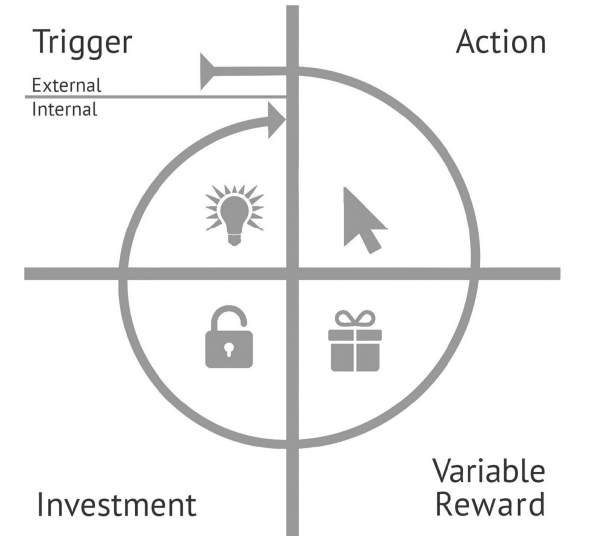
The Hooked model is centered around 4 steps: 1. A Trigger. This is meant to be something that entices the consumer to engage with the product. In the case of phones this is, more often than not, a notification, along with the phone’s vibration. The trigger will lead you into step 2: Action. Seeing the notification, the user will feel an overwhelming desire to perform an action: tapping on it, going into the app and engaging with the content within it. The content will be part of step 3: A Variable Reward. Many times when the user opens the app they will find something rewarding such as a message, a digital prize, anything along those lines. The key, however, lies in the variability and inconsistency of the reward. It will not be available every time the consumer opens the app. Through that, the app is able to create an unsettling sensation, an anxiety and desire for the user to be there so as to not miss a rewarding instance. That way, the user builds the habit of consistently going back to the app because, at some point, there will be something rewarding, the user just doesn’t know when. These behavioral tendencies can be applied to any animal, from rats all the way to tigers; however, humans have a special capacity that permits the success of step 4: Investment. This investment is not limited to monetary value. Haidt describes this investment as being people putting “a bit of themselves into the app.” People become too connected with their Instagram profiles, for example, or feel they cannot stop playing a video game since they spent so much time and maybe even money. This makes it so that picking up your phone constantly and spending hours on it feels natural, feels right and rewarding. Addiction exacerbates the previously stated harms, intensifying the feeling of being dependent and living on the phone, slowly losing regard for the real world.
The Mental Health Declines
Ultimately, the biggest threat imposed by the 4 harms and their consequences is the overwhelming wave of mental illness among teenagers and young adults. The “epidemic of mental-illness”, as Haidt describes, is an unfortunate reality we live in today, and there is data to back it up.

The figure above depicts the percentage of undergraduate students in the U.S. that suffer from some sort of mental illness, ranging from 2008 – 2018. Most notable in the graph are the percentages of students who suffer from either depression or anxiety. Upwards of 20% of students suffer from depression and 25% suffer from anxiety, and the number has likely increased from 6 years ago. The graph below specifies the percentage of teens as young as 12 years old that have shown major depressive episodes in the last year. In both graphs, there is a steady and constant increase that begins between the years of 2010-2015.
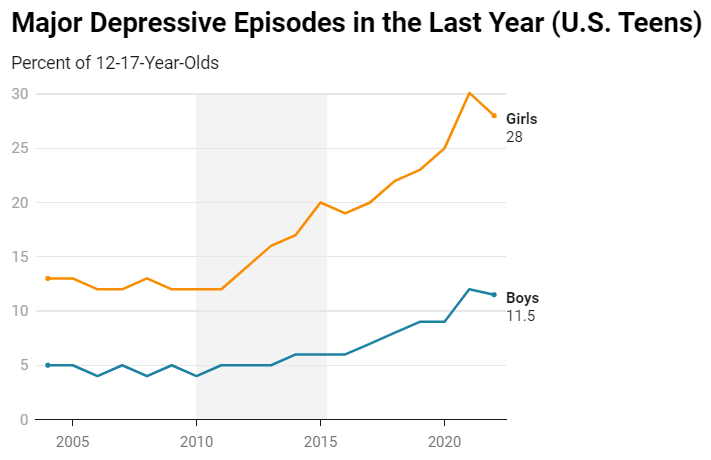
Of course, with the increasingly widespread poor mental health, also comes the increased risk of physical damages, including self inflicted. The following graphs show the average rates of emergency department visits for self-harm in the U.S. per 100,000 teens between 10-14 years old and the rate of girls, of the same age, that were hospitalized due to self harm, respectively.
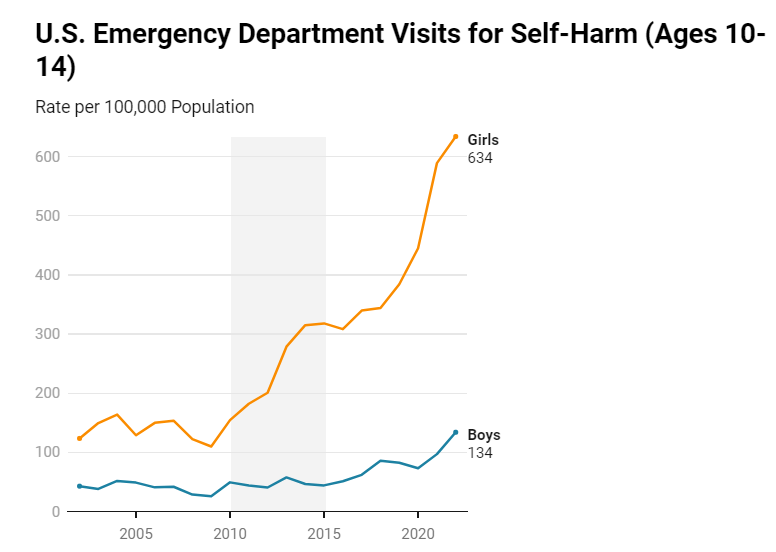

Unsurprisingly, there is a massive increase between 2010 and 2015. The seriousness of self-harm cannot be understated, and with phones being given to young children, cases can begin before the child reaches even their teen years. In the worst case scenario, it could even lead to the person taking their own life.
Conclusion
The “epidemic of mental-illness” is something that is very real and present within our society and can cause dramatic damages to the mental and physical health of people, as well as having a drastic impact on relationships and the academics of students. Phone-free schools are one of the solutions Jonathan Haidt proposes to save the anxious generation, us, and EAC is experimenting with that. Many might think of the school’s ban on phones as an annoyance, or the administration “trying to seem evil”, but that is not the case. Try to keep an open mind and understand that the decision was made to try and protect the students, if only a little during school hours, and prevent us from being subdued by the epidemic.
 EAC PRESS
So the main idea of this article is about the four main hazards that teens have faced since smartphones became commonplace in the early 2010s: social deprivation, sleep deprivation, distraction, and addiction. First of all, I think these are really common phenomena, and the policy of cell phone-free schools is a good solution that schools can come up with. But I just have one question: does this encourage students to become even more addicted to their cell phones in the time after school? Since the school day is not long enough for students to achieve complete abstinence, if such a policy makes students intensify their efforts to play with cell phones at night, is it not more of a vicious circle? But overall, I’m not arguing against Haidt’s proposal, just that make us wondering is it possible to come up with ideas that are more conducive to quitting cell phones?
LikeLike
So the main idea of this article is about the four main hazards that teens have faced since smartphones became commonplace in the early 2010s: social deprivation, sleep deprivation, distraction, and addiction. First of all I think that these are really common and the policy of cell phone free is a good solution that schools can come up with. But I just have one question: does this encourage students to become even more addicted to their cell phones in the time after school? Since the school day is not long enough for students to achieve complete abstinence, if such a policy makes students intensify their efforts to play with cell phones at night, is it not more of a vicious circle. But overall, I’m not arguing against Haidt’s proposal, just that makes me wondering is it possible to come up with ideas that are more conducive to quitting cell phones?
LikeLike
I am surprised that the problems are more serious than I assume. This problem must be treated carefully. However, the ban on smartphones in school is only temporary in daily life. We need to find a more effective way to prevent and manage the four harms of smartphones.
LikeLike
As I read the article, I was getting more entreating on how cellphones can cause huge problems with mental health. In my opinion I think banning cellphones in school is a good solution to make people interact between each other, and avoiding kids to get distracted during class.
LikeLike
Your idea for this writing was really good as well as the information. You brought a lot of questions made by students and answered it throughout your research. Not only that but you also collected many graphs and researches done by professionals in order to explain better the situation the students find themselves in.
LikeLike