
Introduction
Nowadays, criminality happens in every city in the world, but it is also a scale and distribution that can vary significantly depending on the social, economic, and geographic conditions. Campinas is one of the most populated cities located in the state of São Paulo; it is one of Brazil’s most important economic and technological centers, with a population of more than 1.1 million residents. Campinas hosts universities, industrial parks, logistics hubs, and research centers, making it an important urban hub in the southeastern region of Brazil.
Criminality is an occurrence in every single place in the world, ranging from the simplest communities to the big cities in every country. In fact, the majority of crime occurrences are found to be closer to the Northeastern and Northern regions of Brazil, according to an article published by UOL. Nonetheless, the aim of this article is to inform specifically about the criminality of Campinas, the place we call home.
But how safe is Campinas, actually? Campinas may be thought to be a safe city, as it is close to cities like São Paulo that are relatively dangerous, which minimizes the attention drawn to itself. However, according to Numbeo – the world’s largest cost of living database and a crowdsourced global resource for quality of life data -, a perception form was done relative to how dangerous Campinas actually was, and as a result of this form, it was given a high crime index, with about 65/100, meaning it is a decently dangerous city to be in.
However, perception surveys can not fully represent the crime conditions in a city of more than a million people living. Official data from the São Paulo State Public Security Secretariat (SSP-SP) and the Campinas Violence Indicators Panel show that several major crimes have actually declined over the past decade. From this, it raises an important question: do public fears about crime reflect reality, or are they influenced by specific types of crime and where they occur?
Crime Trends in Campinas
While the everyday person feels more and more unsafe walking the streets of Campinas, data trends have been pointing to a safer city. Major crimes, such as carjacking and homicides, have seen record lows in the last two years. On top of this, Campinas’ homicide rate is well below average, with an average of 13 fewer homicides per 100,000 people. And contrary to popular belief, there has been no surge in violence in recent years, remaining slightly declining or stable. Carjacking, on the other hand, has gone down significantly compared to pre-2018 levels. Compared to the 2010s, Campinas seems to be in a much safer situation.
Specifically, reports from the São Paulo Public Security Secretariat confirm this trend, as in recent years, Campinas has recorded homicide rates below the national average. This is a notable change compared to earlier decades, when violence was significantly more widespread across Brazilian cities.
Furthermore, according to state crime reports, theft and robbery remain the most commonly reported crimes, with thousands of occurrences registered each year. However, these crimes are typically non-fatal and often occur in crowded areas or commercial centers rather than residential areas, such as bus stops, which (discussed more in depth forward) is a frequent location of occurrence.
Despite improvements in certain crime indicators, other forms of violence remain significant concerns for the population. Domestic violence, for instance, affects a large number of families and often goes unnoticed compared to other street crimes. In contrast, domestic violence, a crime with a high incidence rate, has been going under the radar of public awareness. Unfortunately, women and children are the main victims, which leaves them structurally embedded in a vulnerable group.
Geography of Crime in Campinas
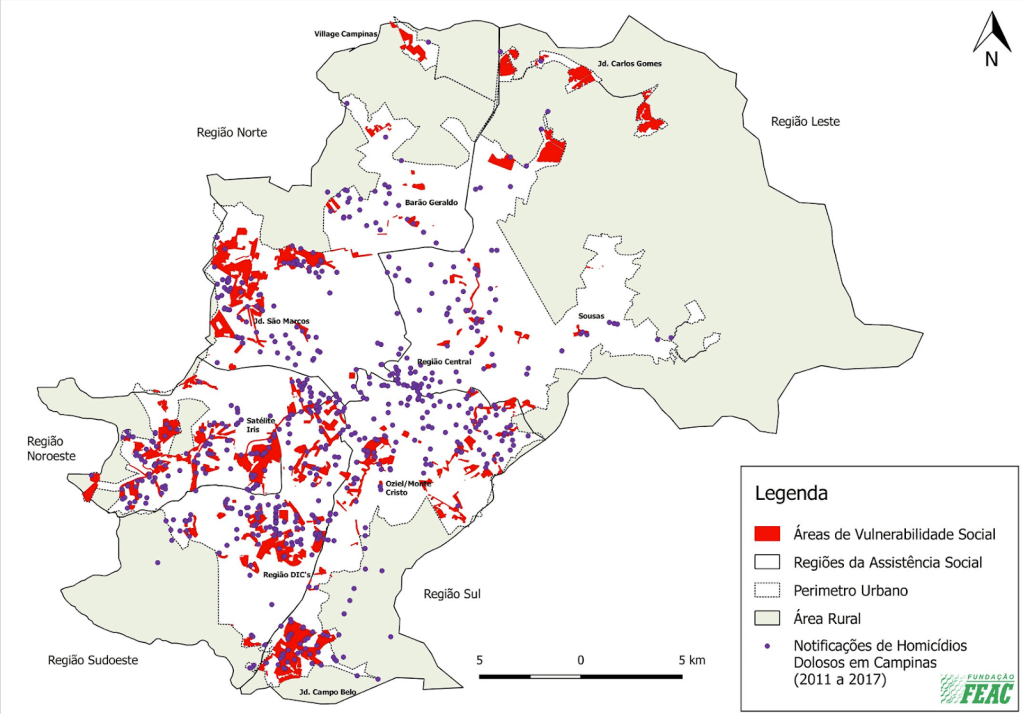
Crime in Campinas is not evenly distributed across the city; it tends to concentrate in specific areas that face greater social and economic challenges. As such, crime rates prevail in some specific neighborhoods and districts. According to the Diagnostico socioterritorial by Fundação FEAC, homicides show that some areas have much higher intensities of occurrence than others, revealing distinct hotspots of violence throughout the municipality.
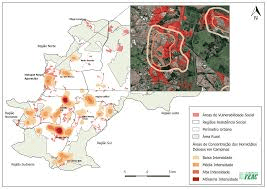
Looking at the map, it is possible to identify certain concentrations of crime rates, especially in areas of the Northwest and Southwest regions of Campinas. Additionally, according to the FEAC research, it was found that the South and the Southwest regions both have the highest amount of homicides, both recorded to be 228 from 2011 to 2017.
Additionally, reports from the Fundacao FEAC socioterritorial diagnosis reveal that a large proportion of violent crimes occur in areas with lower income levels, limited infrastructure, and fewer public services. Being able to analyze that, according to FEAC, approximately 72% of the crimes were committed in the interior of Campinas, or close to areas of social vulnerability. This may be caused by the low-income population there and the lack of infrastructure present in the area compared to the wealthier areas in the North, such as Barão Geraldo.
The Campinas Violence Indicators Panel further confirms the location of frequent robberies and thefts: they occur at bus terminals and among crowds of pedestrians in commercial and street markets. In 2025 alone, 278 cellphone thefts were reported, with 168 occurring inside the buses and 110 outside the transport.
These geographic patterns emphasize how such crime demographics reveal the social inequalities of the region. Neighborhoods that experience greater economic difficulties may also face challenges such as fewer employment opportunities, lower school completion rates, and reduced access to transportation or public services.
Perception vs Reality
Although official data shows improvements in certain crime indicators, many residents still feel unsafe. This gap between perception and reality can be explained by the types of crimes people experience.
So why is the number so high if the homicide numbers and carjacking are down? A hypothesis for this is that robberies are happening at a higher frequency in the center, Barão Geraldo, and Cambui. This generates insecurities among commuters, students, and store owners.
Unlike homicides, which are often concentrated in specific districts, theft and robbery frequently occur in commercial areas and transportation hubs where many residents spend their daily routines (bus stops, for example).
For instance, a homicide in the lower-income parts of Campinas does not affect the daily routine of middle-class residents in Cambui, but a stolen phone does. This drives up the insecurity rate to large proportions while focusing on the entirely wrong statistic.
Perception surveys, such as one conducted by Numbeo, attempted to measure how safe residents felt in their environment. Specifically, in Campinas, the platform currently reports a crime index of roughly 65, indicating that many respondents perceive crime as a serious issue. However, it is important to consider the methodology behind these surveys.
It is important to understand that Numbeo surveyed only 110 people. While these responses are helpful in understanding public perceptions of crime, the small sample size may not fully represent the experiences of the entire population of São Paulo. Therefore, the results should be interpreted with caution and considered in conjunction with other official crime statistics.
Another good alternative for informing yourself on crime is through media coverage. Residents of Campinas frequently consume news about crime in the broader São Paulo metropolitan region, which can blur geographic boundaries and make local crime appear more widespread than it actually is, as it is updated with the most recent occurrences on the spot.
Everyday Crimes Affecting Residents
While violent crimes such as homicide have declined, everyday crimes such as theft continue to affect many residents.
Crime theft in Campinas, especially bike and cellphone theft, is a crime that most commonly affects residents of Campinas. As theft is the most commonly reported crime in Campinas, it is unsurprising that crime reports from the São Paulo State Department of Public Security show that theft is the most reported crime.
The Campinas Violence Indicators Panel further confirms that the most frequent robberies and thefts occur in bus terminals and among the crowds of pedestrians in the commercial and street markets. Cellphones and bikes are the most commonly targeted items because cellphones are easy to steal and quick to resell, while bikes are easy to take when left unattended in public.
This is seen from the São Paulo State Department of Public Security, revealing how 1340 thefts were registered merely in February 2025, which contrasts with the 322 robberies and vehicle thefts (same month). In a longer view, a total of 4428 incidents of robbery and theft were registered in Campinas between January and June of 2025, where the central region of Campinas had the greatest concentration of crimes reported. As such, since theft is the most commonly reported crime in Campinas, it is unsurprising that crime reports from the São Paulo State Department of Public Security show that theft is the most frequent crime.
Conclusion
Campinas remains one of the most economically developed and dynamic cities in the state of São Paulo. However, like any other large urban center, it faces ongoing challenges related to crime and public safety.
Overall, the danger in Campinas is much more where you are, rather than in your feelings. Many studies regarding the safety of Campinas show how places that are actually dangerous don’t receive much attention, and places where serious crimes rarely occur receive various reports on them.
Crime patterns in the city are decided based on geography, inequality, and the types of crimes residents experience most frequently. While serious crimes such as homicide have decreased in recent years, theft and robbery continue to influence how safe people feel in their everyday lives.
As a result, people get more scared about the areas that aren’t very dangerous but have many reports about them because they are more well-known; rather than being scared of areas that are actually dangerous but receive less attention.
Understanding the difference between perception and statistical reality can help residents make more informed decisions about safety and encourage policymakers to focus on resources in areas where they are most needed.
 EAC PRESS