Written by: Gabriel Pedro, André Dantas, Clara Bagaroli
When someone mentions our country, Brazil, a variety of subjects and topics come to mind, such as the most popular cities, such as the Rio de Janeiro and São Paulo, and the stunning natural attractions, such as the unique biodiversity and geographical elements. Nonetheless, another main subject that comes to mind is the high level of crime, which is most often caused by large criminal factions that dominate some regions of the country. One infamous faction is named the Primeiro Comando da Capital (PCC), which will be the main focus of this article.
History
The emergence of Primeiro Comando da Capital (PCC) in 1993 served as a response to the crisis within the São Paulo prison system, often characterized by overcrowding, violence, and a lack of effective public policies. This emergence followed a tragic and well-known event in Brazil, the Carandiru Massacre, which highlighted state brutality and the vulnerability of inmates, generating revolt and strengthening the need for internal organization among prisoners. In this context, the PCC was born within prisons with a discourse of unity, mutual protection, and resistance to oppression, seeking to guarantee basic rights that the State failed to ensure. Therefore, more than a simple criminal faction, its origin is related to state omission, which opened space for the consolidation of a group capable of structuring power and influence both inside and outside the prison system.
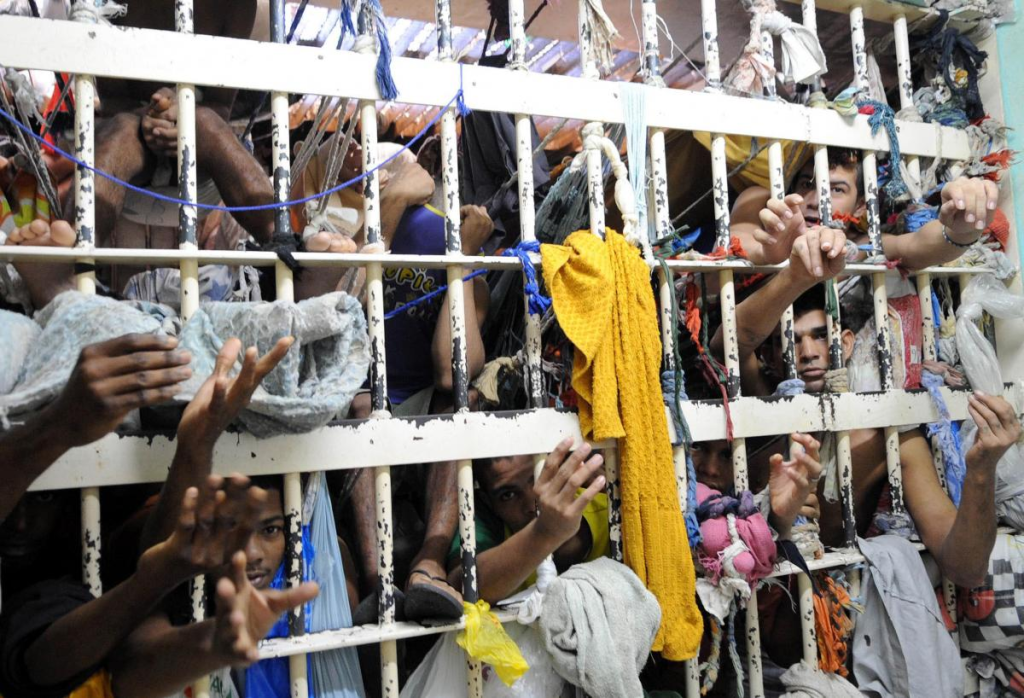
One main crisis that consolidated the PCC as a national threat was the “Salve Geral,” a mass murder orchestrated by the PCC that occurred in 2006 on Mother’s Day. This began when the São Paulo government transported 765 PCC leaders to maximum security prisons, such as Presidente Venceslau, aiming to hinder the communication network of the PCC. In response, the PCC delivered the “salve geral,” triggering massive rebellions that spread outside the prison. As a result, across 11 days, 564 casualties were reported, alongside 110 people severely injured.
Current status of the PCC
In the present date, the PCC has established a wide array of influence and regional control. Below is a map that visually portrays the regions where the PCC imposes a greater influence/dominion.
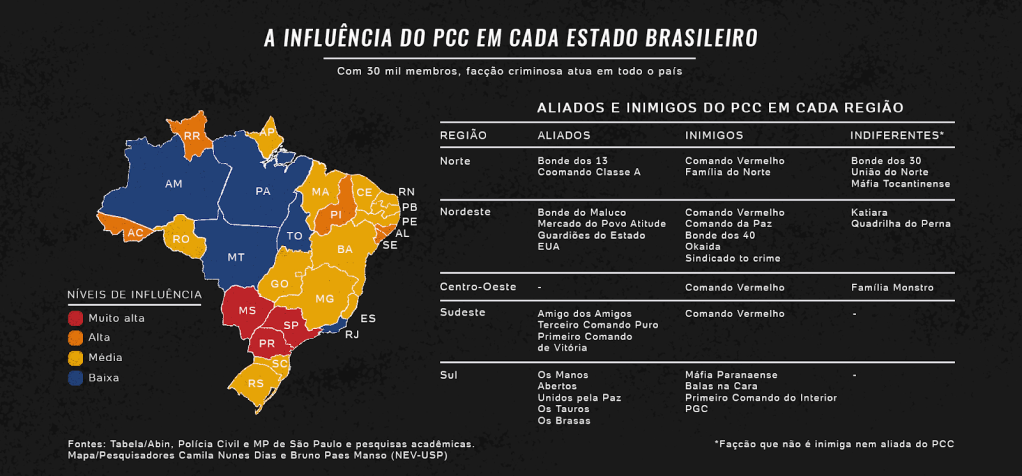
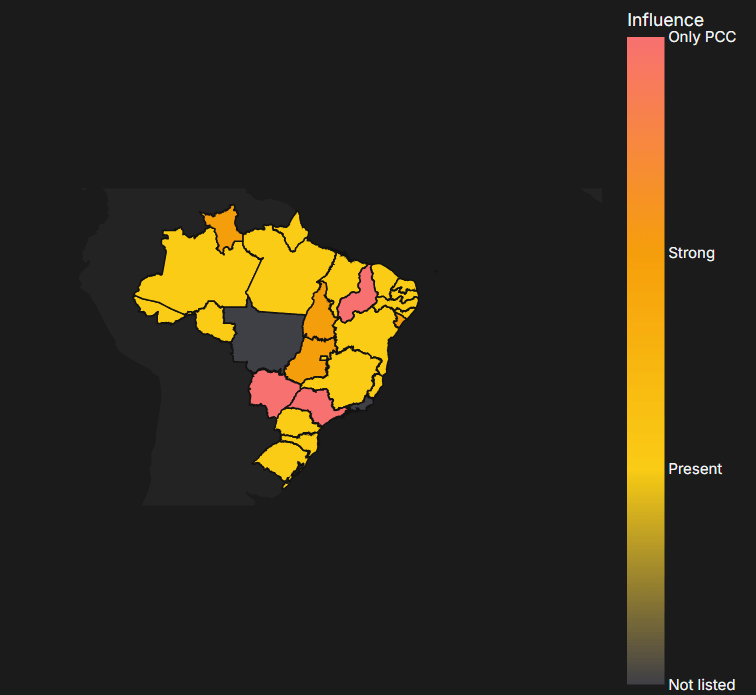
As is evident, PCC has a large influence over the Brazilian territory, with the main dominance being in Mato Grosso do Sul, Paraná, and São Paulo. Please note that this map is from 2018; thus, after 8 years, it is expected that the influence of the PCC has expanded over other states. In contrast, a more recent article (https://estudio.r7.com/as-53-faccoes-criminosas-do-brasil-15042024) of 2022 exposed the influence range of the PCC. The map below was created by us and shows a more recent depiction of the PCC’s influence.
It is also critical to know that the PCC has reached the point where criminals have influence/presence in international countries. Below is another map that displays the different countries.
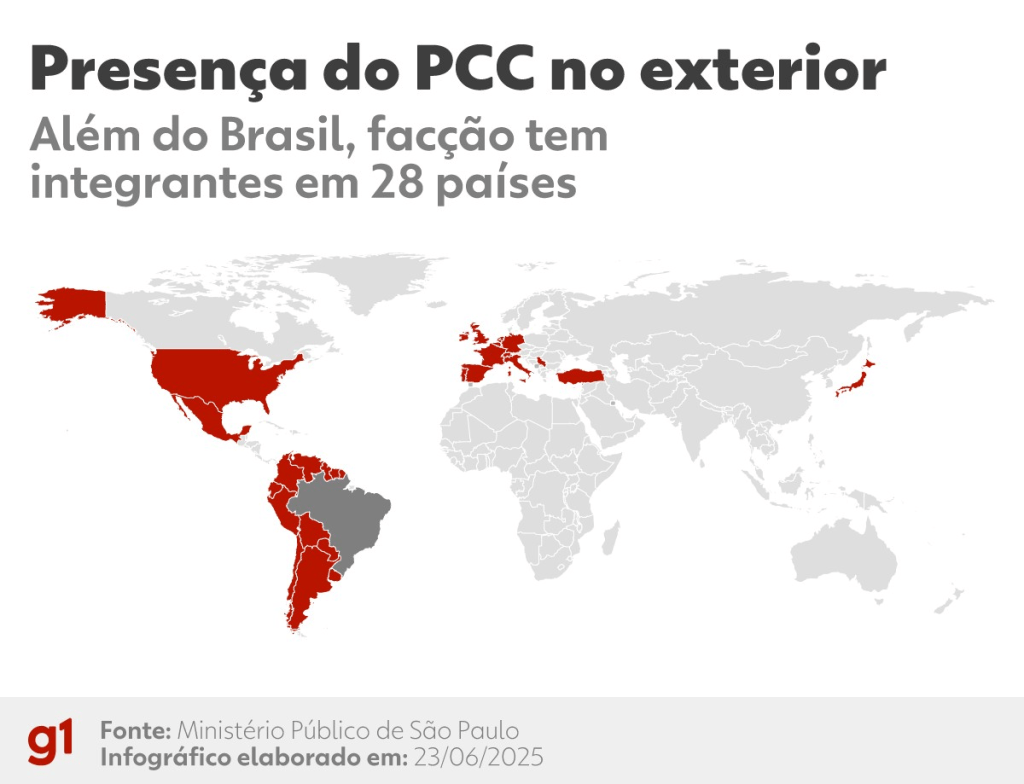
According to this recent map, the PCC has been able to spread its influence throughout the entire South American Continent, a large section of the Central American Continent, and a significant portion of the North American continent. Furthermore, the extensive power of the PCC managed to reach intercontinental countries, being influential in Japan, the Middle Eastern countries, and many European countries. With this spread, it can be said that the further influential spread of the PCC will only expand; nonetheless, it is worth noting that in some areas, the PCC might not have been able to spread its influence due to the presence of other powerful criminal factions, such as the Cartel’s influence in Panama.
Influence
The PCC’s influence is characterized as a parallel authority, sometimes replacing the state entirely, and in place is their own regulation and control. They establish this sphere of influence inside prisons or urban peripheral areas, and impose rules, a sort of crime code that regulates behavior. They control the local economy, including the local drug trade routes. Most of the time, the communities seem even normal, as the PCC abstains from continuous violence, only using occasional shows of force when someone steps out of line or to re-ignite the fear and respect for the organization in the community. In some cases, the community also embraces the PCC rule, as government negligence leaves no one to enforce the law, and the PCC controls crime so as not to harm the local economy, needed to move and peddle products. This leads to a direct decrease in crime towards small business owners and members of the community, which lets the PCC gain popularity. In fact, when there is a large concentration of PCC activity in são paulo prisons, the prisons reported a drop in prison deaths from 522 in 1999 to 377 in 2006. Also, the PCC often holds undocumented trials for “criminals” in communities, but with violent and extreme consequences, to maintain the community’s approval and respect.
Command Chain
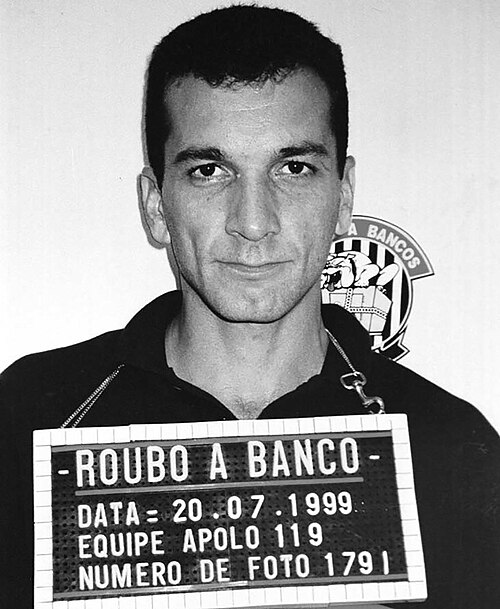
Inside these PCC activity zones lies a complex chain of command. The PCC operates on many different levels and even in different branches of the government. All the PCC answers to the leadership are also known as sintonia final. The “Sintonias” control finance, communication, and the logistics of the crime organization. Most of the leadership operates entirely from within prisons, which are controlled by the PCC, as they are safe from the law but can still send messages out of the prisons and receive communications from the outside. They communicated through their lawyers, smuggled cell phones and “salves”, messages carried outside of the prison reaching every single PCC group. Marco Willians Herbas Camacho, or Marcola, is considered the top gun of the PCC, and he has been in jail since 1999. Despite this, he remains fully operational and is linked to the 2006 “salve geral” attacks on São Paulo, which he allegedly orchestrated while being inside the prison.
Conclusion
The PCC is not just a simple crime organization; it is a web of complex hierarchical systems and drug routes that reflect the failures of the Brazilian State. Rooted in power vacuums in crime-ridden communities neglected by the government, and rampant corruption in government systems and prisons, the PCC is a product of the failures of Brazilian society. Because of this, it is not only a threat to Brazil, but also to other nations, which it has since expanded to and become active in. Increased police activity and more shootouts are not sufficient to quell this disease, which spreads through Brazil. Long-term solutions like reforms in prisons, government outreach programs to marginalized communities, and an institutional purge of crime are necessary to cause any change in Brazilian society and reduce the influence of dangerous crime syndicates.
References
https://pt.wikipedia.org/wiki/Primeiro_Comando_da_Capitalhttps://www.politize.com.br/pcc-e-faccoes-criminosas/&sa=D&source=docs&ust=1774978356086054&usg=AOvVaw3TvtfmIZeIyVLHjd4dPHeZ
https://pt.wikisource.org/wiki/Estatuto_do_PCC https://en.wikipedia.org/wiki/Marcola
 EAC PRESS