
Written by Arthur de Melo Ellwanger
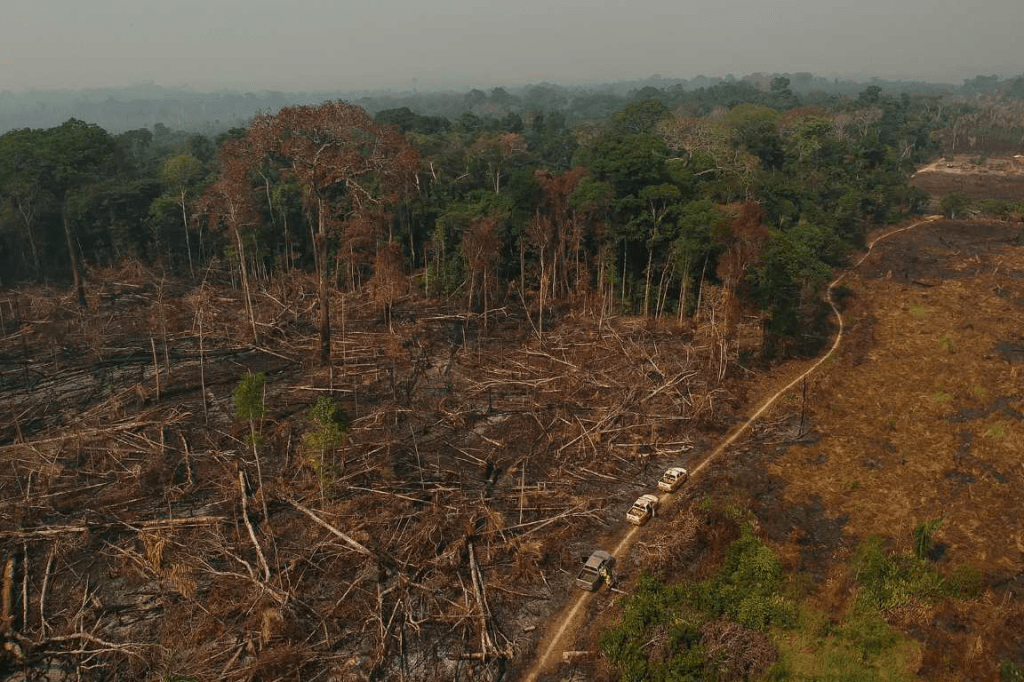
The Amazon is the largest tropical forest in the world and plays a very important role in the environment, helping to regulate the climate and providing shelter to thousands of species of plants and animals. However, deforestation in the region is increasing rapidly due to logging, the creation of farms and the construction of roads and cities. Meanwhile, indigenous peoples and traditional communities, who have lived in the forest for centuries, tend to take better care of the land and preserve it. In this study, we will look for data on deforestation, understand how it affects these communities and listen to experts to find out more about the issue. We will also use Google Earth to map the deforested areas and indigenous lands, helping to visualize the problem more clearly
Impacts of deforestation
Deforestation in the Amazon has serious environmental consequences, including climate change (if you want a more in-depth explanation, check out the article by journalist yeachan) and loss of biodiversity. Studies indicate that the Amazon, which previously absorbed large amounts of CO₂, has seen its capacity reduced in recent decades; this mostly happened because of deforestation and wildfires. A study published in 2021 By Stephen Eisenhammer and Oliver Griffin tells us that more than 10 thousand species of plants and animals are in risk of extinction because of the deforestation of the region, they also say that 35% of these areas already are deforested or degraded. Some studies made by INPE point that between August of 2023 and July of 2024, approximately 6,288 square kilometers of forest were destroyed, marking a 30.6% decrease from the previous year
Relationship between indigenous people and forest preservation
Indigenous peoples do a great job in conserving the Amazon. Indigenous lands represent a large part of Brazil’s forests. Studies conducted by South Dakota State University (USA) show that these areas preserved by indigenous peoples have a lower degradation rate compared to other regions. Another factor that shows the importance of indigenous peoples in forest preservation is their agricultural knowledge. Indigenous peoples have sustainable tactics that have been developed over the years and these practices do not harm the environment and preserve native species.
Mapping using Google Earth
We used Google Earth to mark areas of extractive reserves and indigenous lands that were preserved from deforestation. Using this tool, we were able to visualize the difference between a preserved area and an invaded area. Looking at the image below, we can clearly see that the “Parakanã” indigenous land is much more preserved with forests and without deforestation than all the cities that are around this indigenous land. If you want to see other areas of indigenous preservation and areas of extractive reserves, click on Google Earth and you will be sent to our page with some demarcations of some lands. Also, if you know other areas of preservation of indigenous lands or extractive reserves, you can write the name and coordinates of the place in this form that we created so we can enrich our work as much as possible.

The preservation of the Amazon is essential for the planet’s environmental balance and for the survival of the communities that live there. We also need to recognize the role of indigenous peoples, as this is essential for us to be able to develop more effective protection strategies. If we can have sustainable initiatives and use advanced technology, it will be possible to improve economic development and environmental conservation.
 EAC PRESS