
Written by Yechan Han
“The earth does not belong to man, man belongs to the earth. All things are connected like the blood that unites us all. Man did not weave the web of life, he is merely a strand in it. Whatever he does to the web, he does to himself.” – Chief Seattle on December, 1854.
The Earth’s temperature is a result of a delicate balance between incoming solar radiation, heat absorption and emission, and the greenhouse effect. This balance is critical in maintaining a climate of the Earth that maintains the lives of numerous species and protects our environment. However, the temperature of the Earth is increasing constantly, changing the climate of the Earth in countless places, threatening the lives of numerous species and our environment. The main reason is due to the contribution of global warming, which is related to the process of the greenhouse effect. Hence, in order to understand the greenhouse effect, it is important to understand some several key processes, which are: the way heat is transferred and retained on Earth, including solar intensity, infrared radiation, and albedo.
Source of heat and temperature: Solar Intensity, Infrared Radiation, and Albedo
Firstly, solar intensity refers to the amount of sunlight that falls on a certain area per unit of time. The sun emits energy in the form of electromagnetic waves, primarily in the ultraviolet (UV), visible light, and infrared (IR) spectrum. While UV radiation plays a role in atmospheric chemistry (such as ozone formation and depletion), infrared radiation, which is essentially heat energy, is crucial in the Earth’s thermal balance. This means that infrared radiation is one of the ways that transfer heat from one object to another. However, not all of the infrared radiation from the sun is transferred to the Earth or otherwise, we won’t be able to survive on the Earth! When solar radiation reaches the Earth, some of it is absorbed by the Earth’s atmosphere, and some of them reflected back into space, which can be explained by the scientific term albedo. Albedo is the ratio of reflected light to incoming light, showing how much a body scatters(reflects) the radiation. Hence, higher albedo means that a body reflects a large amount of light while low albedo means that a body reflects a small amount of light. The Earth has an albedo of roughly 0.3, meaning 30% of the radiation from the Sun is reflected back into space while 70% of the sunlight reaches the Earth. It is important to note that this value is a rough approximation since all places have different albedo. Therefore, once 70% of the radiation from the sunlight is absorbed by the atmosphere, the heat is emitted to the Earth’s surface, where we live, in the form of infrared radiation. Nevertheless, according to this theory, the Earth’s temperature will keep rising every minute which will explode the Earth since the Sun constantly emits infrared radiation to the Earth. Then, how are we still alive?
Earth’s Maintenance of Temperature: Emissivity
The reason why the Earth does not explode is because every solid object emits the heat that it absorbs, which can be explained by another scientific term, emissivity. Emissivity is the ratio of the energy radiated from a body’s surface to that radiated from a perfect emitter, known as a blackbody. Since the black body emits every energy, or heat, that it absorbs, emissivity demonstrates how much energy a body emits compared to the energy that it absorbs. Hence, since the Earth has an emissivity of roughly 0.8, the Earth emits 80% of the energy, or heat, that it absorbs. This explains why the Earth’s temperature is constant and does not explode since Earth also emits the heat that it receives from the Sun. However, there is one more problem, if the Earth only absorbs 70% of the heat from the sunlight and emits 80% of the energy that it has, the Earth’s natural temperature, based on this energy exchange, would be approximately -18°C, which will be impossible for any spices to survive on the Earth. Just like this:

The Greenhouse Effect: Earth’s Natural Thermal Blanket
However, Earth maintains an average temperature of about 15°C, not -18°C, how is this possible?
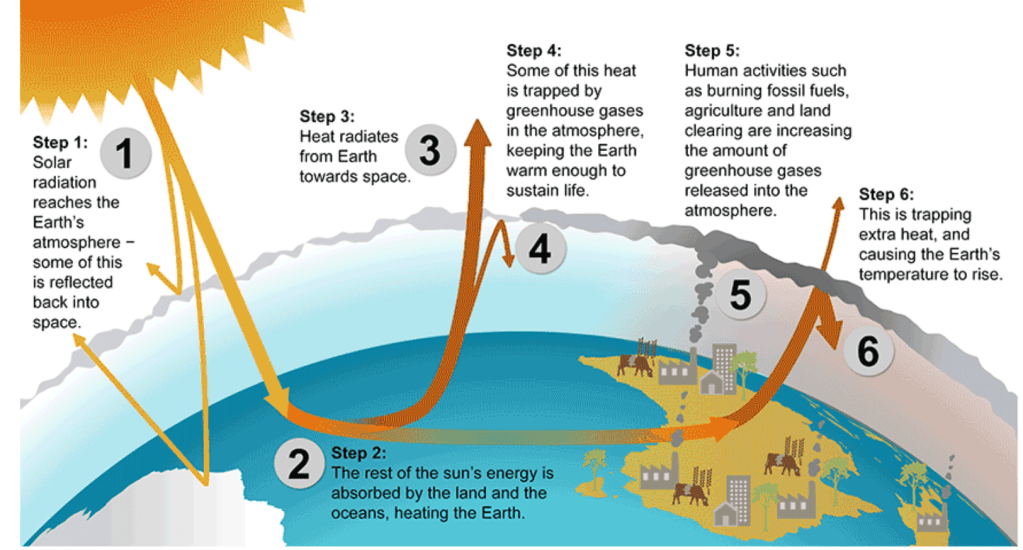
This is due to the greenhouse effect. The greenhouse effect is a natural process that keeps the Earth at a habitable temperature. As discussed above, when the Earth absorbs heat from the sunlight, Earth emits some of the heat back into space. However, some of this heat that is emitted by the Earth is re-absorbed by the Earth’s atmosphere, by some of the greenhouse gases in the atmosphere—such as carbon dioxide (CO2), methane (CH4), and nitrous oxide (N2O). When these greenhouse gases absorb the heat from the Earth’s surface, they re-emit heat into all directions, including the Earth’s surface, meaning that some of this radiation comes back to the Earth’s surface. Hence, this re-emission of infrared radiation by greenhouse gases acts like a thermal blanket, regulating temperature and maintaining conditions suitable for life. In other words, this process effectively traps heat within the Earth’s atmospheric system, preventing all infrared radiation from escaping into space, which keeps Earth’s temperature constant and warm. Here is a picture for a brief explanation of the greenhouse effect.
Then, What Is The Problem?
Current human activities increase the concentration of greenhouse gases in the atmosphere, meaning that we are producing more greenhouse gases than is needed to maintain Earth’s temperature. Therefore, more production of greenhouse gases means that the concentrations of the greenhouse gases in the atmosphere increase, which leads to more heat coming back to the Earth, which consequently leads to the increase in Earth’s temperature, global warming.
How Can We Solve Global Warming?
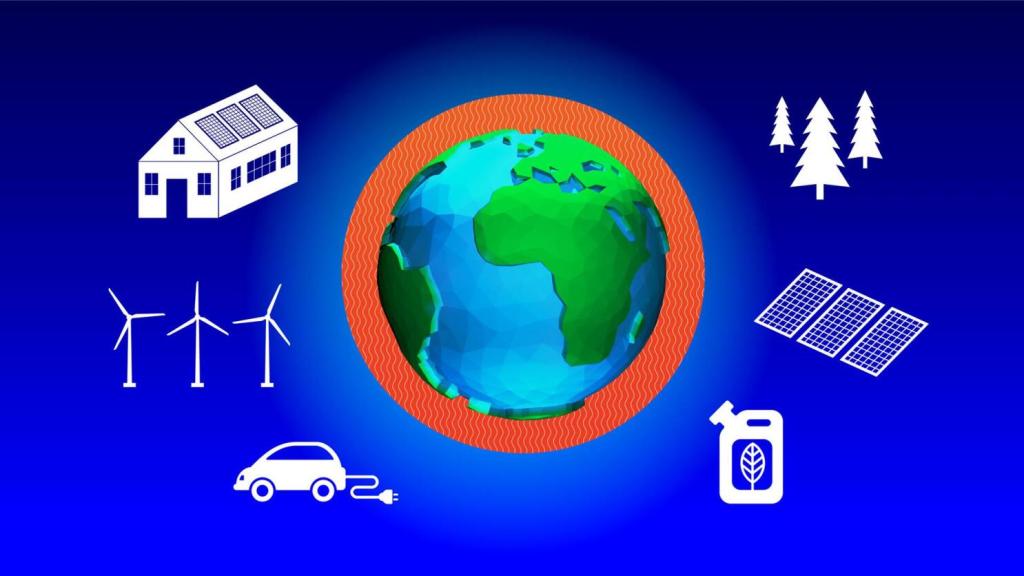
Well, the obvious solution is to decrease the amount of greenhouse gases produced by human activities. As discussed above, greenhouse gases are carbon dioxide (CO2), methane (CH4), and nitrous oxide (N2O), and we have to reduce those gases. Here are some possible solutions for reducing greenhouse gases.
1. Reduce Greenhouse Gas Emissions
- Transition to Renewable Energy – Increase the use of solar, wind, hydro, and geothermal energy instead of fossil fuels, since fossil fuels emit CO2.
- Improve Energy Efficiency – Use energy-efficient appliances, LED lighting, and better insulation in buildings.
- Sustainable Transportation – Promote electric vehicles (EVs), public transport, biking, and walking to reduce reliance on gasoline and diesel which also emit greenhouse gases.
2. Carbon Capture and Storage (CCS)
- Develop technologies that capture CO₂ emissions from power plants and industrial sources before they reach the atmosphere.
- Enhance natural carbon sinks, such as forests and soil, to absorb more CO₂.
3. Reforestation and Afforestation
- Plant more trees to absorb CO₂ through photosynthesis.
- Protect existing forests from deforestation, illegal logging, and land conversion.
4. Sustainable Agriculture and Land Use
- Reduce methane emissions from livestock through improved feed and farming practices since methane is released by the digestive system of grazing animals.
- Encourage organic farming, crop rotation, and agroforestry to maintain soil health since nitrous oxide is released by extensive use of fertilizer.
- Reduce food waste to lower emissions from food production and decomposition.
5. Promote Circular Economy
- Reduce, reuse, and recycle materials to minimize waste and lower carbon footprints.
- Encourage the use of biodegradable and eco-friendly packaging.
Example: Paris Agreement
Here is an example of a global initiative that focuses on solving global warming:
Paris Agreement: The Paris Agreement is a legally binding international treaty on climate change. On December 12, 2015, during the UN Climate Change Conference (COP21) in France, it was approved by 196 Parties and it became operative on November 4, 2016. Its main objective is to “limit the temperature increase to 1.5°C above pre-industrial levels” and to keep “the increase in the global average temperature to well below 2°C above pre-industrial levels.”

Successes
Global Commitment – Nearly every country in the world has joined the agreement, demonstrating widespread recognition of climate change as a global issue.
Flexibility and Inclusivity – Unlike previous climate treaties, the Paris Agreement allows countries to set their own emissions reduction targets (Nationally Determined Contributions, or NDCs), making participation easier.
Push for Net-Zero Emissions – Many countries have set long-term goals to achieve carbon neutrality, with major economies like the U.S., EU, China, and India announcing ambitious plans.
Increased Investment in Renewable Energy – The agreement has spurred investments in renewable energy and sustainable development projects.
Challenges and Shortcomings
Emissions Still Rising – Despite pledges, global greenhouse gas emissions continue to increase, and the world is not on track to limit warming to 1.5°C above pre-industrial levels.
Non-Binding Nature – The agreement lacks enforcement mechanisms. Countries can set their own targets but face no strict penalties for failing to meet them.
Insufficient Financial Support – Developing nations require financial and technological assistance to transition to greener economies, but developed nations have fallen short of their funding commitments.
Slow Policy Implementation – While targets are set, many governments struggle with political and economic barriers that delay actual policy changes.
Therefore, the Paris Agreement is a step in the right direction, but its success depends on stronger commitments, better enforcement, and faster implementation. While it has fostered global collaboration and awareness, much more needs to be done to meet its goals effectively.
Conclusion
In conclusion, the interaction of solar intensity, infrared radiation, albedo, and the greenhouse effect determines Earth’s temperature and climate. Solar energy drives the system, infrared radiation transfers heat, albedo influences how much energy is absorbed or reflected, and the greenhouse effect retains warmth to sustain life. While this natural process is essential, human activities are altering the balance by increasing greenhouse gas concentrations, leading to global warming. Understanding these interconnected mechanisms is crucial for addressing climate change and ensuring a stable future for the planet.
 EAC PRESS