Recently, many people are suffering from the impacts of flooding in Rio Grande do Sul, one of the extreme disasters caused by heavy rain and storms. The continuous huge amount of rain in Rio Grande do Sul makes Guaiba Lake reach the maximum water levels historically.
In 2023, the floodings of Rio Grande de Sul had happened three times. The cyclone that occurred in June released 16 deaths, also a similar phenomenon in September killed 54 people. Even the rain in November killed an additional 5 people. Throughout one year (2023), people died due to natural disasters related to rain. Some experts considered it a sign of emergency. Despite the issues happening, the investment for the protection of flooding was not increased to reduce the causes of the flooding. Additionally, the investment has been decreasing since 2021.

The cause of flooding in Rio Grande do Sul

Geographic structure is one of the contributions of flooding in Rio Grande do Sul. The states affected by flooding have lowland territories. Low-lying terrain is bound to be greatly affected by flooding when water overflows. The northern part of the municipality where Filho International Airport is located is flooded and will be closed indefinitely and all operations will be suspended. In addition, the lake crossing the Porto Alegre flows to the ocean collecting from the stream and rain. The speed of water flow in the Guaíba River is too fast due to the altitude. The more water entering into the river than usual makes the levels of water exceed 3 meters, leading to reaching 5.26 meters. Furthermore, the Atlantic Ocean was influenced by the heavy rain and storms happening in Rio Grande do Sul. The rapid rise of the seal level impedes the flow of water from rivers to the ocean. Due to heavy rain and rapid water flow, water levels rose significantly, submerging low-lying cities.


The massive amount of heavy rain in one week is also considered a reason why the flooding in Rio Grande do Sul. The average amount of rain in one week is 1,500mm, which is ¼ of the anticipated amount of rain in Rio Grande do Sul. The alert of heavy rain on 21, April brings the first flooding caused in Canosas, Novo Hamburgo, and Porto on 27, April, releasing the first death due to flooding. Unstoppable heaving rain contributes to an increase of over 4m of water levels in Guiaba Lake. As a result, The level of the water rose uncontrollably so the influential flooding affected people’s daily lives.
The perspective of the experts is that the flooding in Rio Grande do Sul happens due to people’s low awareness of climate change. Also, people always make solutions for the protection of the disaster after the situation has already worsened. They demonstrate concerns about potential problems throughout Brazil. Moreover, the investment in these problems is low due to the few numbers of the government.
The impact of the flooding
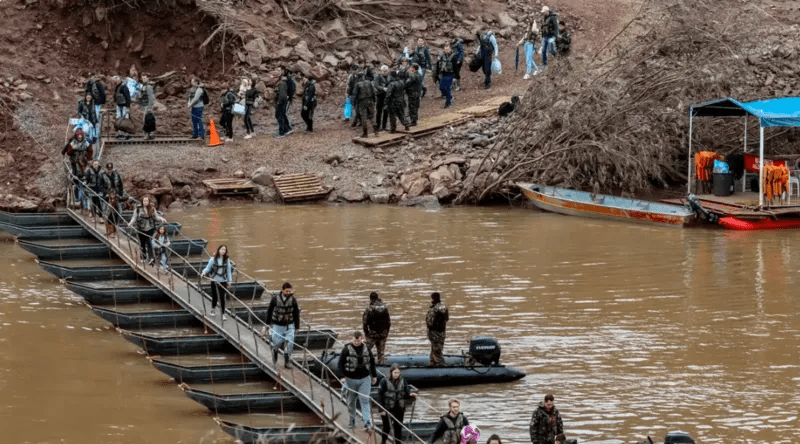
The continuous flooding in Rio Grande do Sul increases the number of victims. According to the Civil Defense report, about 2.3 million people have been affected by the heavy rain and flooding. Based on the confirmation recorded until 25, may, the entire death toll increased to 169. There are 806 people injured and Rio Grande do Sul’s public security are still striving to find 56 people missing. Due to the huge impacts of the flooding, 581,000 people became homeless and 469 municipalities were affected. 55,000 people who lose their residence are in shelters provided by the government. Helicopters strive to rescue isolated residents, from flooding. The serious problem is the levels of water in the Guaiba Rivers are too high, leading to incessant impacts on the people and states.
Most of the essential resources available for people to use were desecrated so reconstruction is urgent for the people. The traffic infrastructure, movement evacuation, and rescue victims are in panic due to the destruction of the environment. Moreover, the food and energy supply face challenges due to the limitation of transportation. The connections among the necessary resources make reconstruction and restoration impossible. Above 800,000 people do not get the supply of electricity, which estimates mobile carriers (Tim, Vivo, and Claro) are affected by the flooding. More than 1,000 schools were affected by the risk so about 350,000 students suffered to go to the schools. 1 million houses do not get the water supply because there are concerns about contamination of the water supply chain. The worst water quality leads to an increase in the rate of causing the disease.
Rio Grande do Sul is urgent to take action against the flooding, but there are many challenges in implementing immediately due to the massive impacts of the flooding. Because the restoration of the cities is possible when the water level decreases under 3 meters. Thorough preparation before causing tragic disasters is necessary for the future.
 EAC PRESS