Stress is defined as a state of emotional strain resulting from adverse or demanding circumstances, the body and mind react to stresses that come from within or outside. Stress causes reductions to every bodily system. For example, palpitations, perspiration, dry mouth, shortness of breath, fidgeting, rapid speech, intensification of unpleasant emotions and extended stress exhaustion. Stress is an inevitable part of modern life, affecting everyone regardless of age, gender, or background. It is brought on by multiple factors, like the over the top demand from school or work. Though stress is not controllable, most people who are often affected by it have methods to alleviate the feeling. School is naturally a stress inducing environment.
Not every stressful feeling is the same, according to the Brazilian Ministry of Health, some describe their stress as usually more intense, short, and usually caused by a specific reason such as the death of a relative, this less common version of stress is called acute stress. Others experience the more common version of stress, also known as chronic stress, which is a continuous more constant feeling of stress that repeats on a daily basis at a lower intensity. Acute and chronic stress both possess distinct characteristics as well as effects on the human experiencing them. Acute stress will usually occur when an individual is dealing with a one time traumatic or straining event, such as a car crash, a deadline they must meet, or a medical emergency. Acute stress will usually go away after the resolving of the issue. Identifiable symptoms of acute stress include anxiety, trouble breathing, insomnia, mood swings, among others. On the other hand, Chronic stress is the mental and bodily response to stressors that tend to repeat themselves and are ongoing in one’s life. Examples of stressors that lead to this long term stress are constantly demanding jobs, constant financial difficulties, or even a toxic relationship. Consequences of chronic stress range from constantly low energy, aches throughout the body, to heart disease and changes in appetite.
Many people may be looking for a concrete solution to their stress, but it is important to understand that they must first assess their situations and their symptoms prior to jumping to a solution.
”Once you’ve gone through that process of identifying, then it’s kind of pausing for a minute and planning.” said Marta Bidoli (EAC counselor), this shows that professionals advise that you combat stress one step at a time. First, you want to identify your source of stress, for some this may be easy, for others, the source of their stress may be difficult to identify. There is no problem with this, this is the reason we have psychiatrists and therapists all over the world willing to help. Second, attempt multiple ways to alleviate that stressful feeling, and with differing types of stress comes differing ways of coping, for example doing exercise, playing video games, reading a book, listening to music, watching a show, or even meditation. All these examples have one thing alike, they take your mind off what you are experiencing that is causing stress. It is important to note that not all people can deal with stress in the same manner, you must find something that works for you, so do not be discouraged when a certain method does not automatically take away that tension.
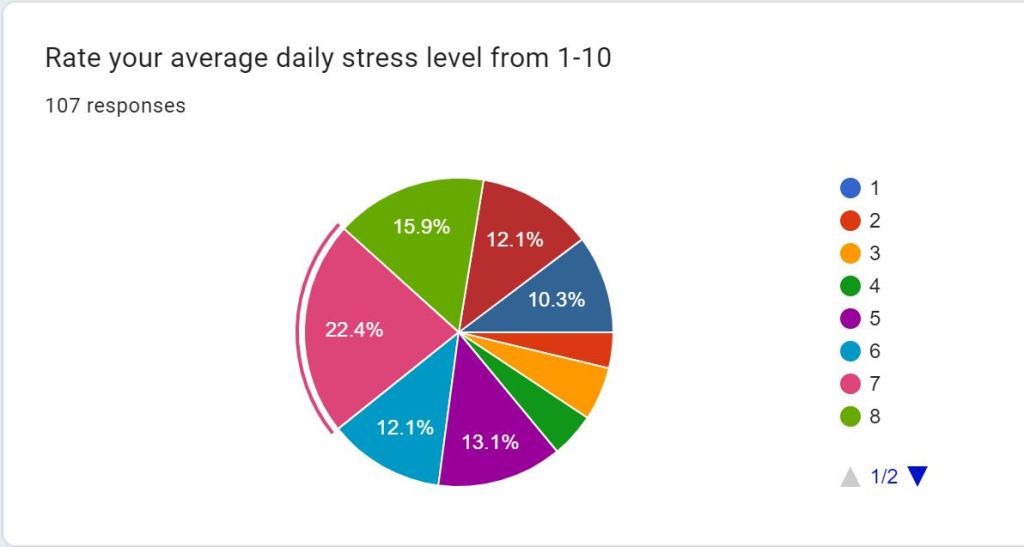
We asked the EAC upper school student body to answer a couple questions about their daily stress, this is what they had to say: In EAC, students in upper school (6th-12th) tend to rate their daily stress level at a 7 (1-10). The main area of stress coming from school work load. Though school work may be intimidating, when you do nothing about it and simply procrastinate, your situation may worsen. This point was emphasized when Marta Bidoli said “When people are stressed in general, we tend to procrastinate more, and that usually increases the stress. Procrastination is not about time management, it’s usually about the feeling you have when you start doing the work.” In order to combat this, 33 upper school students say they listen to music, while 22 others claim that sleeping is what allows them to decompress. Other minority groups mentioned playing video games, participating in sports, drawing, or going for walks. It is important to mention that in EAC, we are constantly supported within the classroom. “A good thing about our school is that councilors are in the classrooms with students every week.” Marta said, she looks for specific traits every week in students in attempt to identify which ones may need help opening up about their stress and in and out of school issues, Marta provided multiple alarming factors including: “When a student is constantly working on something else during the class, and when you walk around, they’re doing something else in math class that isn’t math, or something else in advisory that isn’t advisory.” Marta’s tips were to take your problems one at a time, and take time with your decision making when dealing with stress, lastly, make sure to know that there are always people willing to talk to you about your issues, ” you don’t really get any bigger award or prize for going through stress on your own.” Said Marta.
Stress is a common emotional and physical response to challenging or demanding situations, affecting people of all ages and backgrounds. It can manifest in various forms, such as acute stress from specific events or chronic stress from ongoing stressors, leading to a range of physical and emotional symptoms. To manage stress effectively, it is essential to identify its source and explore various coping strategies tailored to individual needs. Seeking professional help is also crucial when stress becomes overwhelming. In the EAC upper school, many students experience stress, and they cope through various methods like listening to music or engaging in hobbies.
 EAC PRESS