
A little over two years ago, I did a review of the first Dune movie by Denis Villeneuve. A common criticism I’ve heard people saying is that it’s a movie that cannot be watched without having read the book before, which I agree with; the world of Dune by Frank Herbert – the book the story was based on – is absolutely difficult to digest, especially in only three hours. For those who have read the first Dune book, however, it is probably the closest possible thing we could get to a real, authentic and accurate cinematic depiction of the Dune world.
Dune: Part 2 was released internationally on the 1st of March, 2024. It went on a massive press tour with its stars Timothee Chalamet, Florence Pugh, Zendaya, Austin Butler, among others, and its prevalence in the media has amounted to huge numbers of fans. Mid-March, the sequel to Dune had already amassed a grand total of U$500 million, surpassing its original by about U$100 million, and likely going millions more over from then till now. It is difficult to put into perspective the impact this movie has had on pop culture in the few weeks it has been out.
Cinema has been going through a rough patch recently. Especially action cinema, has suffered the Marvel plague, which gets worse every year. Every year since Avengers: Endgame, they release another mediocre sequel or movie that people watch only because it was made by Marvel, not because of its inherent quality. Every movie they have released since the end of what they called phase 3 – which includes titles like Guardians of the Galaxy, Infinity War, Avengers: Civil War – have been, at best, alright because of fan-service and at worse, downright cashgrabby. One of the worst movies I’ve ever seen, and with a 47% rating on Rotten Tomatoes, is Eternals: generally considered shallow, overdone, and more of the same things we have always seen from Marvel. I don’t necessarily agree with the sentiment that every Marvel movie follows the same exact formula, but with every new movie that comes out with only a few humorous statements and a superficial message, I begin to dislike the new era of Marvel movies more and more. Although, I think the latest installment of Guardians of the Galaxy was pretty incredible, and in my opinion the best phase four Marvel movie. Good Marvel movies have become an exception, not a rule.
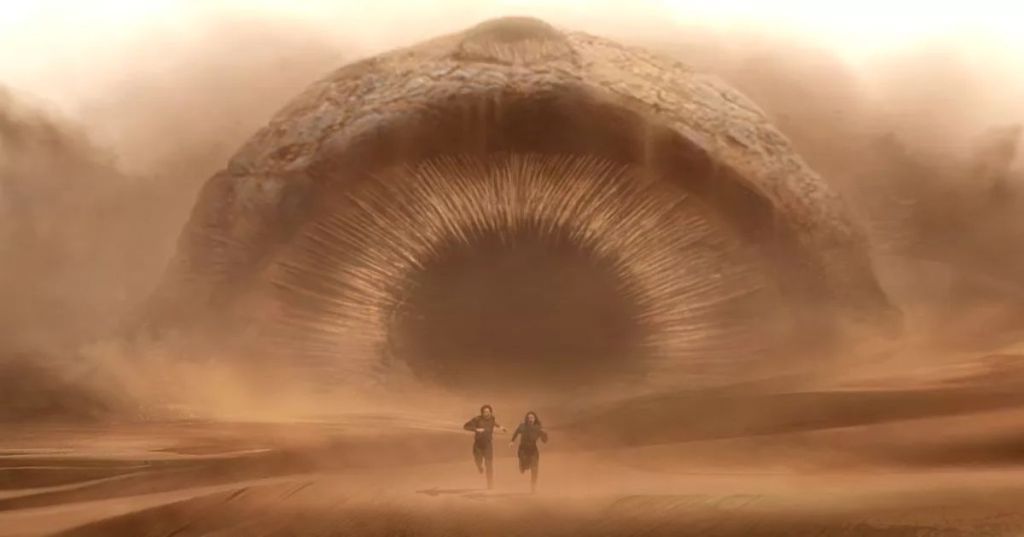
Action Cinema being as good as Dune: Part 2 is a rarity. The sheer scale and impressiveness that exudes from the screen on my first viewing of the sequel is something I’ve likely ceased to experience. The CGI, especially, is what caught my attention watching the movie for the first time on the big screen, and the score as well is fantastic. It is not overbearing and does not overstay its welcome; it works simply to enhance the atmosphere of Arrakis. Paul’s theme song, too, is incredible. It encapsulates his glory and presence to the Fremen, the prophecy he will fulfill. The ability of the CGI to make the sandworms appear so real, while being so unimaginably huge and fantastic.
The acting, as well, certainly deserves a mention. I’ve said before how Timothee Chalamet is the perfect Paul; I don’t believe there is anyone else who could truly capture the character development of Paul in the novel by Frank Herbert, and Austin Butler is truly excellent at portraying a true psychopath – Feyd Rautha. Chalamet is able to convey how both young and wise Paul is; wise beyond his years, and able to see decades into the future. Truly, I think Austin Butler shines in this movie. He is only on screen for a minimal amount of time, appearing for the first time in the second half, but his presence is overwhelming and extremely memorable in hindsight. Not to mention, the black teeth and the bald head make him all the more terrifying. He has such a unique character design, unlike anything else we have seen and it serves to truly encapsulate the energy of the Harkonnen: how they are alien-like and far past saving and bringing back to their humanity.

The scenery of Dune is truly mesmerizing, and every scene of the endless expanse of the dunes of sand make me gape in awe. Fun fact: the scenes from Caladan were filmed in Stadlandet, Norway, while the scenes in Arrakis were filmed in Jordan. The idea that our planet is so diverse as to be able to portray multiple different planets is incredible, and so well-used in the sets of Dune. I cannot even begin to imagine the budget allocated for this feat of cinematography.
– SPOILERS START HERE –
There are some notable differences between Dune, the movie, and Dune, the book. Off the top of my head, Chani was a lot more accepting of Paul as the Messiah in the book; in the movie, she was one of the only people openly defiant of the prophecy that everyone else seemed to believe in, which I think was a welcome change. It enhanced her role as a character while also adding more nuance to the Bene Gesserit, especially. The idea of their role in politics as manipulators and controllers is one of the most interesting parts of the Dune world, and the acknowledgement that they are, at their core, self-serving and manipulative helps further their cause without the necessity of having to include too much exposition. The most common criticism to the character of Paul is that he represents the “white savior,” the outsider that comes to save the impoverished, and his character furthers an idea of white superiority in some ways. The addition of Chani’s defiance of Paul helps balance this criticism extremely well: it frames Paul as more manipulative than initially believed, and the question of if he seeks raw power or the good of the Fremen always hangs in the air for the duration of the film: as it should be.
Every action sequence is a hit in this movie. The first time Paul was able to ride a sandworm is perhaps the most memorable scene of film I have in mind: unparalleled in the sense of accomplishment that exudes from Paul when he does it. It also makes me realize how susceptible I’d be; if Paul showed up in my hometown and started riding sandworms and predicting people’s futures, I’d likely be persuaded to believe his prophecy, too. The battle scene between the Fremen and the Harkonnens: oh my god. It is incredible. The scale. The amount of soldiers rendered to truly emphasize the impact of Paul. The sandworms! I think there is little stopping this movie from winning a significant amount of Oscars next year. This is the kind of movie that makes you leave the movie theater upset that you live on Earth and not Arrakis; that you’ll never experience the grandeur of a battle between the Fremen and the Harkonnen.
This is not to say that there are no flaws in the movie. I think it is somewhat close to being flawless, but it is flawed nonetheless. Notably, I think there is little emphasis on why Paul had to marry Irulan–the Emperor’s daughter. A quote from Paul speaking to Chani in the novel reads:
“I swear to you now … that you’ll need no title. That woman over there will be my wife and you but a concubine because this is a political thing and we must weld peace out of this moment, enlist the Great Houses of the Landsraad. We must obey the forms. Yet that princess shall have no more of me than my name. No child of mine nor touch nor softness of glance, nor instant of desire.”
There is little in the movie that indicates truly why Paul had to marry Irulan; many people may have left the movie theater with the sentiment that Paul was betraying Chani for no reason other than a greed for power–this is untrue. He had the duty to marry Irulan to keep peace in the empire, but he would never love her. Truly, the person who will suffer the most because of this marriage is Irulan herself, who will never experience love in her marriage. In many ways, this ending draws parallels between Chani and Jessica, for both of them are now mere concubines when history will “call them wives.” This is my biggest criticism of the Dune movie; it is much more a nitpick than a criticism, but I digress.
Dune: Part 2 is perhaps the best action movie I’ve seen in the last few years of my life. Granted, action is not my favorite genre and by far not the genre I watch the most, so take everything in this review with a grain of salt. I sit patiently in anticipation of Dune: Messiah, which I hope will live up to the universe these first two movies have built.
 EAC PRESS