The world we live in is fast changing due to the rise of Artificial Intelligence, and the art industry is no exception. Through a positive lens, the use of AI in the art world has created new opportunities for innovation and creativity; helping artists with ideas for their projects and even new art pieces. In a way, it can be argued that AI is revolutionizing the ways in which we produce, consume, and perceive art, from creating original works to improve the way in which artists produce. It is important to consider how AI is transforming the art world and what this can mean for the direction of art in the future. As there can be advantages and drawbacks of AI in the arts, ethical issues with its application, and how AI can affect preconceived ideas about creativity and authorship. By examining these issues, there can be a deeper understanding of the impact that AI is having on the art world and what it means for the future of artistic expression.
However, you may be asking the question, how does AI even create art? Although there are many different intelligences coming into the scene for this industry, the creation of art using AI can be seen as a form of collaboration between humans and machines. With that being said, some examples of the biggest programs currently would be Generative Adversarial Networks (GANs), Computer-aided drawing tools, Image classification systems, and Art chatbots.
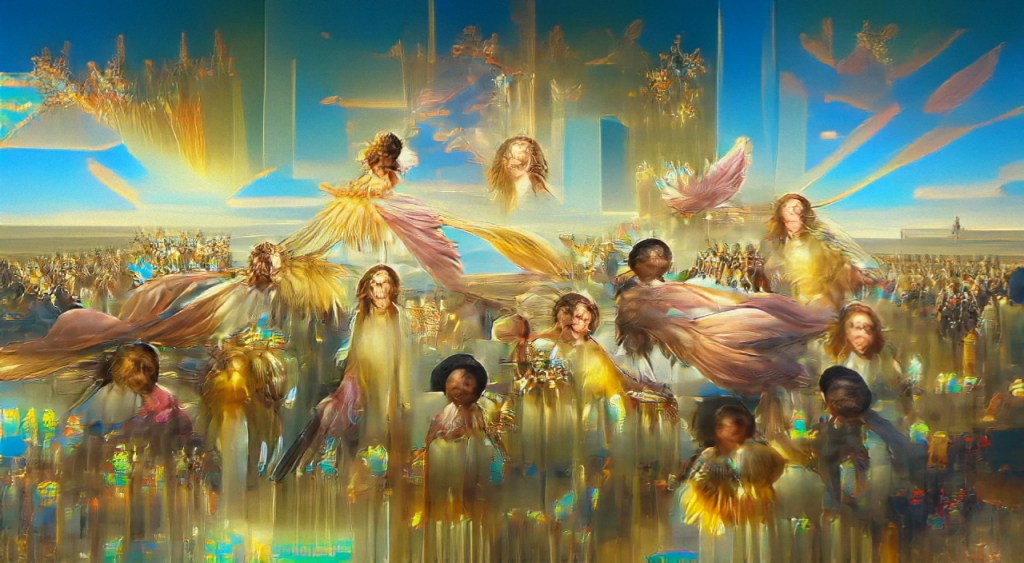
The GANs are made up of two neural networks: a discriminator and a generator that cooperate to produce images that resemble the artist’s training and reference images. The discriminator network separates reference photos from actual images using the random images that the generator network generates and transmits to it. The generator then modifies its outputs over time to generate images that are more and more similar to the training images. Its method allows for the quick and effective creation of a wide range of images. Here is an example from the software:
Other than the GANs, a popular but more well-known form of AI that can influence the Art World is Computer-aided drawing tools. These tools allow artists to create digital art, which has been an art style for a long time, although this AI gives artists input on colors, textures, and styles. There are several such tools on the market, from complex software like Adobe Photoshop and Corel Painter to simpler and more accessible apps like Procreate. In these cases, AI is used to analyze the work of artists and give suggestions that can help achieve the desired result.
Image Classification Systems are another popular technique in creating AI-generated art. This system is used to recognize patterns in existent art as well as used to generate new images, similar to GANs. However, Image Classification Systems are category based. For instance, an artist may use an already-existent image of a cup of coffee to generate other images of the same thing, which take inspiration from the one submitted by the person using that AI.
The last example of Art AIs is Art Chatbots. They are computer programs that interact with users in their own language. Therefore, they can be programmed to generate text, images, and even sound. Artists can type out what they desire, and work together with Art Chatbots by providing information and guidance to the chatbot, which in turn will respond by generating it. This interaction between AI and chatbot can be interesting for the creative processes of art, as it is a new way to work alongside AIs for your work.
Therefore, we can observe that AI has had a huge impact on the art world, and on the creation of art, both by accelerating the creative process and changing traditional concepts of authorship and authenticity in art. These AI tools help artists work at a faster pace as artists can work at faster rate compared to how they would using traditional methods. They can experiment with more ideas, which is useful, however, it can be augmented that AI-generated art is not a creative expression of the artist’s work compared to traditional methods. By speeding up the creative process with a generator, a necessary part of the creative process is stripped from the artist.
According to an interview with The Guardian, author, and illustrator Rob Biddulph said that AI-generated art “is the exact opposite of what I believe art to be. Fundamentally, I have always felt that art is all about translating something that you feel internally into something that exists externally. Whatever form it takes, be it a sculpture, a piece of music, a piece of writing, a performance, or an image, true art is about the creative process much more than it’s about the final piece. And simply pressing a button to generate an image is not a creative process.”
Although many people have been using AI as an experiment and for fun, the ethical aspects of it in the art should also be considered. It is important to consider the fear amongst artists in more recent times, as they are valid voices that deserve to be heard when it comes to this topic.
 EAC PRESS