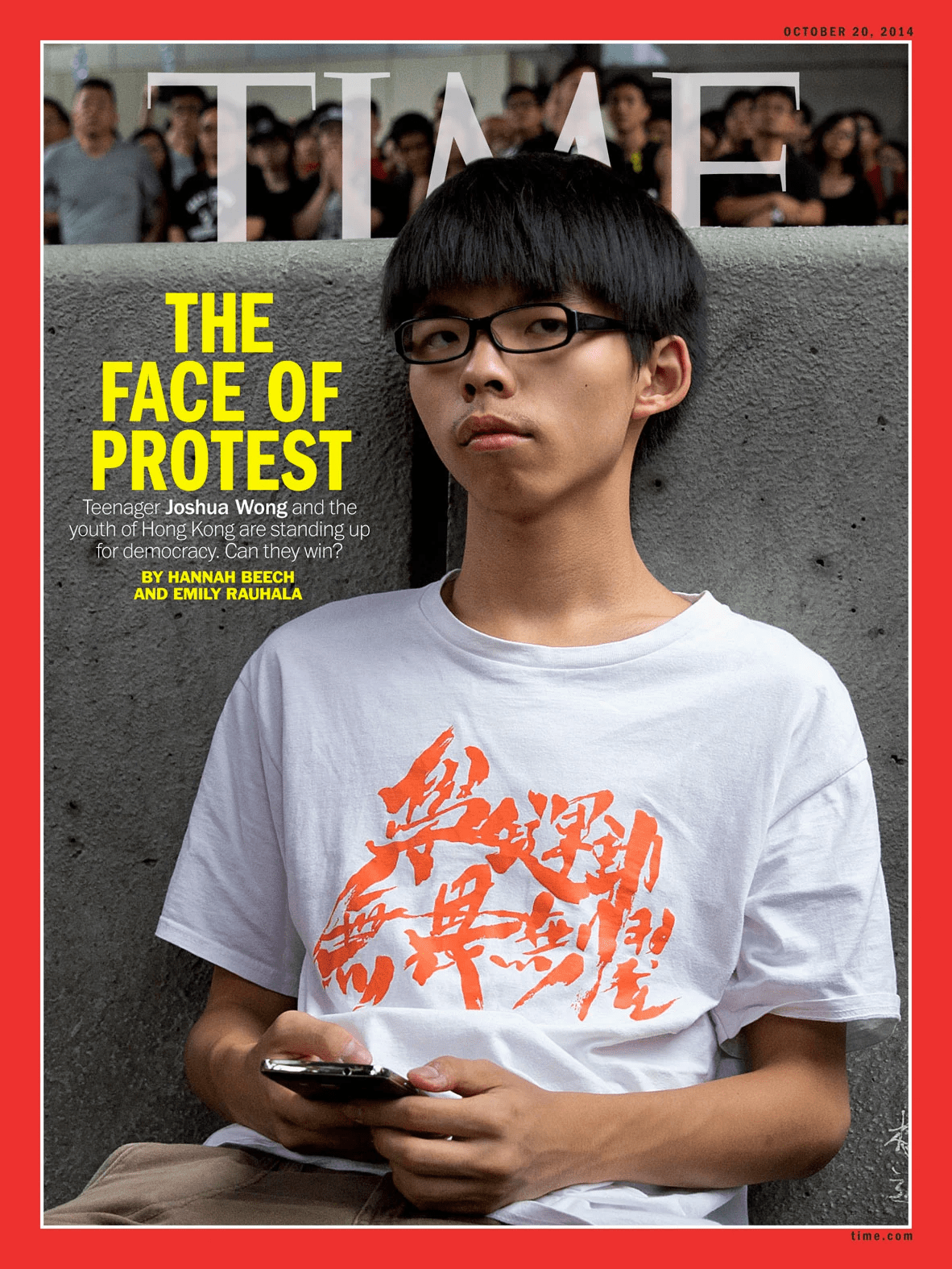
The documentary on Netflix that showed Joshua Wong’s story of generating a civil movement against the Chinese government
Image Credits: Time Magazine
In 1997, Hong Kong was handed to the Chinese by the British. However, because Hong Kong had been a British colony for so many years, it had a Western-bred population being a developed and economically important city. China came up with the idea of one country, two systems, where Hong Kong would continue to have a capitalist system with freedom of the press, freedom of assembly, and the right to elect their own leader in the near future. Many people left Hong Kong because they were terrified of what living in China would be like.
In 2012, the government announced plans for national education. However, students fear this is the next step for communist China to take Hong Kong. National Education is a curriculum that brainwashes kids in an attempt to make them support the Communist Government.
Hence, a resistance movement led by young activist Joshua Wong was formed and led to the creation of Scholarism, a group made by Hong Kong students that shared a clear goal against National Education. Members of Scholarism launched an occupation protest at the Hong Kong government building in August 2012 to pressure the administration to abandon its plans to make “Moral and National Education” a required topic. Three of the protesters went on a hunger strike, and fifty people took over the public park beneath the government buildings. Approximately 8,000 protestors in black gathered outside the government offices in preparation for the planned September 3rd demonstration. “No to brainwashing education!” protesters shouted. “Put an end to national education! ”.
The demonstration lasted until September 2012. Fortunately, on 8 September, Leung Chun-Ying, the Chief Executive of Hong Kong declared that schools were allowed to choose the education system implemented by them.
The campaign is considered to have come to an end on September 8 because, despite the fact that protests against the school reform persisted, they were more concerned with the structure of the Chinese government than with the reform itself. On September 8, the protests came to an end as the majority of protesters appeared to be happy with Leung’s choice.

In an effort to voice opposition to the National People’s Congress Standing Committee’s (NPCSC) decision to restrict the nomination process for the election of the Chief Executive of Hong Kong, Scholarism and the Hong Kong Federation of Students (HKFS) announced a class boycott in September 2014. Hence, Scholarism joined the movement of Occupy Central, which advocated for universal suffrage. Reverend Chu Yiu-ming, Benny Tai, and Chan Kin-man launched the civil disobedience movement known as Occupy Central with Love and Peace (OCLP) in Hong Kong on March 27, 2013. The campaign began on September 24, 2014, and was a contributing factor in the 2014 Hong Kong demonstrations. The campaign’s manifesto calls for an electoral system in Hong Kong that is decided through a democratic process and complies with international standards of universal and equal suffrage. The civil disobedience that follows the movement’s first three stages of dialogue, deliberation, and citizen authorization must be nonviolent. The term “Umbrella Revolution” was first used on Twitter by Adam Cotton on September 26, 2014, in reference to the umbrellas that protesters used to protect themselves from police pepper spray.


Beijing’s major concern is that, if left to its own devices, the city might select a pro-democratic candidate, thus sowing the seeds of a movement to rebel against mainland rule. Additionally, any form of successful independence movement would create an unfathomable precedent for a government currently contending with separatist movements in the western areas of Tibet and Xinjiang. The Scholarism movement joined The Occupy Central movement and created more powerful protests against China. Although Occupy Central wasn’t as successful as Scholarism, they still had a great impact on other international communities, showing their dissatisfaction with the world. The Occupy Central was a civil protest that fought for the right to vote in democratic elections. Since it involves a more complex process of changes in a system, Occupy Central wasn’t as successful as Scholarism.
By: Jorge Shiomi and Catarina Araujo
 EAC PRESS