The Legend of the werewolf and how the EAC portuguese teacher, Jaqueline Aguiar, grandfather capture one
The legend of the werewolf dates back to Ancient Greece. In fact, the first testimonies of people who have supposedly come face to face with the creature claim that the Greek emperor, Licaon, was one. Legend has it that the King, who lived in the region of Arcadia, had the tradition of sacrificing travelers. It is said that on a given day, Zeus pretended to be a traveler to meet the emperor, who invited the God to a diner with the intention of killing him. Before he managed to do so, Zeus cursed him, forcing him to transform into a wolf after being served human meat.
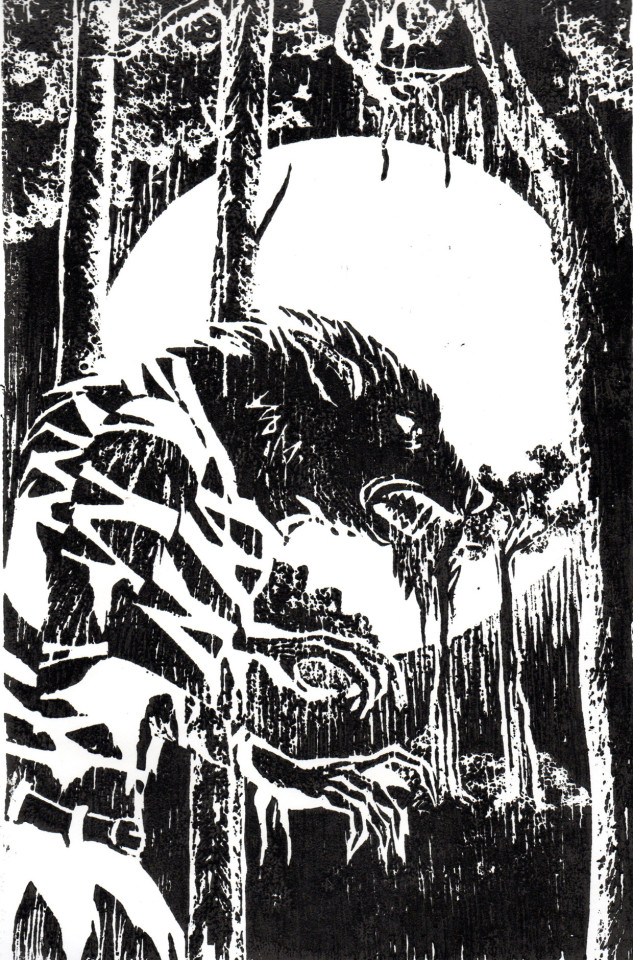
The name of the creature came from the Greek terms lykos (wolf) and anthropos (man). The legend quickly spread to Rome, where the werewolf received the name of versipelio, and parties in honor of the wolves, called lupercalia, were made. The vast domain of the Roman Empire made it possible for the legend to spread throughout Europe.
One version of the legend states that a man or woman would transform into a wolf on nights of full moon and go to cemeteries and hunt on people to feed. According to these reports, only a silver bullet/knife could kill a werewolf. A person could have the ability to lycanthrope (transform into a wolf) because of a curse, heritage, or in case they were attacked by a werewolf and survived.
In Brazil, the legend was introduced by the portuguese. In Portugal, the werewolf was known as a thin man, with long ears, and a big nose, by the names of corredor or tardo. The portuguese version accounts that a person was a lycanthrope if cursed, was predestined (when a was boy born as the youngest sibling to seven girls), or if born as a result of a incest. As there were no records of a creature similar to the werewolf among the ingineous populations of Brazil, the legend of the werewolf remained similar to the one told by the portuguese. Although similar, a huge difference lies in the fact that Brazilian stories only account for men transforming, whereas Portuguese stories include lycanthrope women (often called peeira or lobeiras).
In our school, the Portuguese language teacher, Jaqueline Aguiar, told us the story of how her grandfather, Ismael, captured a werewolf.
Ismael Iglésias, who unfortunately passed away in 1990, allegedly captured a werewolf back in 1958-1960 (the date remains uncertain). Father to 8 children and married to Dona Angela dos Santos Iglésias, Ismael lived and worked in a farm in Paraná, close to Estrada da Prata, also known as Sítio Santa Angela. Being of Spanish descent, the stereotypically angry version of Igleses often showed its colors when he witnessed discrepancies.

Being a hardworking family man, Ismael found himself every weekend meeting with his neighbors to play cards as a source of entertainment. The location of the game often changed between his friends’ houses. One neighbor specifically, Benedito, soon became a source of speculation, as his suspicious behavior caught the group’s attention.
Benedito was said to always leave the game before midnight, especially on Fridays, although the players always stayed past that time. They noticed that whenever he left, the dogs would make a lot of noise, barking relentlessly. In addition to that, he would always wear long sleeves, no matter the weather. A given day they saw Benedito wearing a short-sleeved shirt, which exposed his callused arms, almost resembling that of a dog’s. They soon began assuming that the man could be a werewolf.
One night, while the game was taking place in Ismael’s house, he and his four friends decided to follow Benedito after he left, taking a rope with them. If the man was in fact a werewolf, they wished to capture him. When the noise began, the five men came face to face with a gigantic, monstrous brown dog, one they had never seen before.
They managed to apprehend the dog, despite his violent behavior and substantial size. Locking the dog in a tall building with only one door and a very tall window, they expected him to remain stuck until they returned the next morning. When they opened the door, however, they were surprised to see nothing but a rope lying useless on the floor, the animal apparently having disappeared into thin air.
They theorize that he had probably escaped while in his human form, but when they tried searching for their neighbor, he was nowhere to be found. His family soon followed and moved away. The friend group, after thorough investigation, discovered that Benedito was the eighth kid, born after 7 girls.
Since the story took place in the night of a Quaresma, which is a religious period in which people should be reflecting, the men took the experience as a lesson to not disrespect the time by playing cards. Jacqueline’s grandfather took it upon himself to spread awareness to this encounter and teach others a lesson about being respectful. Although Jaqueline can’t confirm for sure if these events ever did occur, she emphasized that her grandfather had never been a liar, and that he gave people his word that all of it really happened.
References:
https://jundiai.sp.gov.br/noticias/2013/08/06/conheca-o-folclore-brasileiro-no-museu/ https://brasilescola.uol.com.br/folclore/lobisomem.htm
By: Lina Busato and Gabrielle Hadad
 EAC PRESS