
The “bad omen” made rounds on social media after it was found in Chile right before an earthquake.

On July 11th, 2022 fishermen in Arica, Chile, reeled in a 5.8 meter long deep-sea fish. The catch quickly spread around social media getting over 10 million views on a Tik Tok which labeled it a call for impending disaster. The Regalecus glesne, or giant oarfish, known as “the messenger from the Sea God’s palace” in Japanese legends, as well as the “apocalyptic fish,” comes with theories and speculation linking it to earthquakes and tsunamis. Weeks later, after the oarfish’s appearance, there was a 5.3 magnitude earthquake that affected both Chile and Argentina. This earthquake affected the cities of Rancagua, Constitucion, Coquimbo, Huasco and Arica, where the bad omen fish was found. The deep sea fish’s appearances have been followed shortly by natural disasters; however, is this just a myth or is there scientific evidence for this piece of folklore that can be used to predict seismic movements?
The giant oarfish are the longest bony fish in the world, only smaller than the basking sharks and whale sharks. They may reach a length of 17 meters, which is equivalent to a 6 floor building and may weigh up to 270 kilograms. Due to their living environment being 1,000 meters below sea level, where almost no light is able to reach, they are rarely seen in the oceans atmosphere which makes it difficult for scientists to have statistical data about them. The Regalecus glesne are mainly found in warm temperate zones and the tropical waters located mainly under the main pelagic zone. Although many people may fear them due to their immense size, they don’t even have teeth, instead they have gill rakers in order to capture tiny organisms. Their diet is composed of zooplankton, krill, shrimps, squids, jellyfishes, and other types of small crustaceans.
Due to the Regalecus glesne’s immense size and living conditions, it has various physical adaptations. Its long and slender body allows them to move without being affected by the water’s resistance, and the dorsal fins facilitate rapid swimming allowing them to descend vertically. Additionally, the bright red crest positioned from the tip of their head to the rest of their body works as a defensive mechanism in order to scare off other possible predators. As a consequence of their body being able to grow to about 17 meters, all of their organs are located close to their head; therefore, if they lose part of their body they are still able to survive.
Stemming from Japanese folklore, the giant oarfish, like other deep-sea fish, has long been a source of mythology and speculation. Myths of sea serpents in historical registries have been attributed to sightings of the fish by sailors and fishermen, and more recently the fish have become a known bad omen. The folklore states that as “messengers from the Sea God” they come to the surface to bring news of seismic activity, a belief that has been spread globally as the fish have been seen all over the world; to the point of scientists looking to find if the folklore can be backed by evidence.
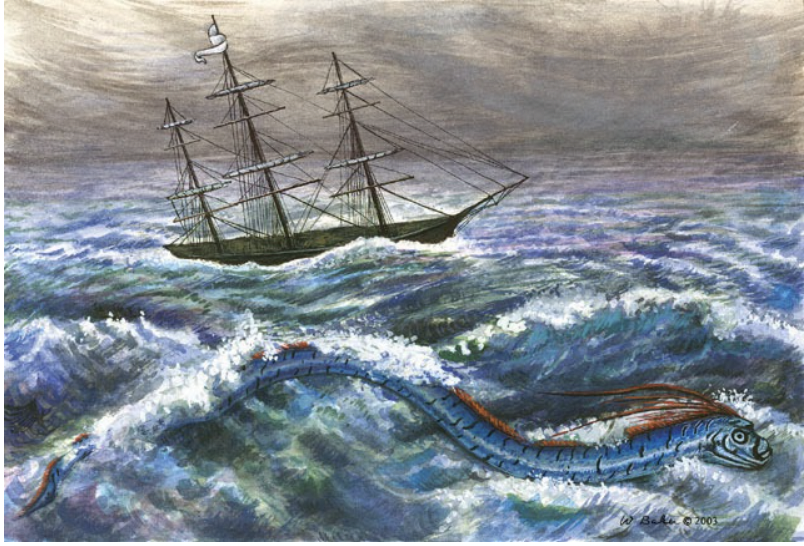
After a devastating 9.1 earthquake in Japan in 2011 was preceded by 20 sightings of the giant fish in the previous year the myth gained even more traction. This led to a scientific study that examined seismic movements since 1928 and their correlation to appearances of deep-sea fish, especially the oarfish. Studies from Tokai University used 221 instances of large earthquakes and 336 instances of fish findings in an attempt to determine the veracity of the legend. However, no direct correlation could be established. On the other hand, science based investigation proved that some ocean organisms are biologically sensitive to upcoming earthquakes, due to vibrations coming from the bottom of the ocean. Hence, some believe that the Regalecus glesne have a “sixth sense.”

EAC’s own biology teacher, Mrs. Melina Leite, theorized that this sixth sense is likely an overdramatization of a true property of the anatomy of deep-sea fish, the lateral line. A sensory mechanism of fish that can form adaptations dependent on the environment in order to detect vibrations and relative movements of water, aiding them in maintaining their orientation in dimly lit areas.
Weeks after the appearance of the Regalecus glesne in Arica there was a magnitude 5.3 earthquake that affected both Chile and Argentina. The piece of folklore with all of its associations and theories, despite confirming superstitions in its latest appearance, can’t be claimed to be a scientific way to predict natural disasters. However, there is a lot left to be learned about deep-sea fishes and their “sixth sense,” such as new information which might solidify or invalidate the legend.
Written by: Luna Consolini, Augusto Nucci
 EAC PRESS