

Wordle, owned and managed now by the New York Times, is a simplistic yet incredibly engaging game, whose popularity seems to have expanded to international levels in recent months.
It was released to the public in October 2021; by November, it averaged 90 players a day, which is impressive for a game that had only been out for a month, yet it could never compare to how many players would play it daily in the following months. It would captivate people around the world with its simplicity, amounting to almost 300,000 daily players, according to the New York Times themselves.
Wordle is a game in which players have 6 attempts to guess one five-letter word; every time a player enters a word, the site offers hints, given by colors: when the letter is yellow, it’s in the word but in the wrong spot; colored green, the letter is in the right spot; if it’s completely grayed out, it’s not present in the word at all. When the word is right, you win the game, and the site shows the player their statistics, or how many words they’ve gotten right in a row, and the percentage of how many games they’ve played versus won.
The game itself is overwhelmingly simple when you take its success into account. In fact, its simplicity might be the cause for such inordinate achievements. Even still, its massive popularity has attracted spin-offs and other similar games to be created, where players, instead of guessing words, will guess countries, basketball players, math equations…
In other words, Wordle has exponentially increased in popularity, and many people have wondered, considering its popularity, how it was able to do so in such a short amount of time?
Well, I believe it’s due to a combination of things. Firstly, Wordle is a one-play-a-day kind of game. There’s one word per day and the same word everywhere. The site itself has no ads, no flashy graphics, or irritating pings reminding you to play. There are no levels to go through or never-ending chances, no pricey add-ons or data collection. In fact, it’s a very different experience from a lot of what we have gotten used to in the ad-riddled world of social media.
Despite this, scores can still be shared online, although in a way where there are no spoilers as to what the “word of the day” is, given in this format:
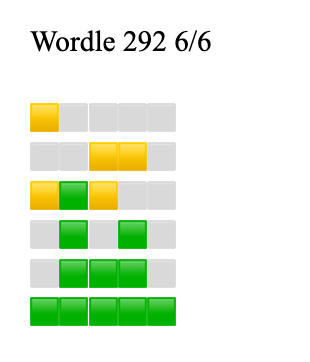
These types of results have done rounds all over Twitter, Tik Tok, Instagram…
In addition, the game is characteristic of being neither too easy nor too difficult, and it’s memorable because, unlike many other games, it’s not something designed to be addictive. Rather, it’s a game that simply happens to be addictive. In fact, the fact that you can only play one time every day actually makes it simultaneously harder to binge but easier to become addicted to the action of logging in to the site and trying to guess the word.
Speaking from personal experience and from many others, people can find themselves waiting for the clock to strike midnight simply because it meant they would play wordle again, excited to keep their streaks alive and share their scores with their friends. A psychologist and the managing director of Enliven Counselling & Wellbeing Centre named Fatima Abdullah has said the following: “Wordle offers a platform for people all over the world to join in on a daily target or task, which is to successfully guess the word of the day and share their scores. This creates a playful, casual environment.”
This previous statement closely aligns with the situation we have just come out of: the pandemic. after such a long time being disconnected from one another, it is important to find ways of being able to reconnect as a society.
Many people have also begun sharing not only their scores but their own personal strategies to find the day’s word in the least amount of tries. Many people start with the same word every time (words with lots of vowels or commonly used consonants); others say it’s much more fun to start with random words every single day.
Despite this, Wordle’s recent purchase by the New York Times, one of the world’s most influential newspapers, has caused some controversy. In the few days that followed said purchase, players were hit with words they’d never heard before. Faced with lots of backlash, the New York Times learned from its mistake and has since offered “easier” and more realistic words, as that is part of the appeal of the game itself. In addition, many are scared that those things that made the game so enjoyable (the lack of ads and flashy graphics) would be lost when a larger company bought it out.
It is a hope for many, me included, that the New York times is able to stay true to the game’s original intentions and that its appeal is not lost to the world of corporations and ad revenue.
To conclude, Wordle is a vastly simple game that has captured the brains and hearts of people around the world. We can hold out hope for the fact that it remains this way, and that it retains its original charm for the people out there.
Play Wordle here.
Resources:
https://wtop.com/tech/2022/02/the-appeal-of-wordle-a-neurologists-view/
 EAC PRESS