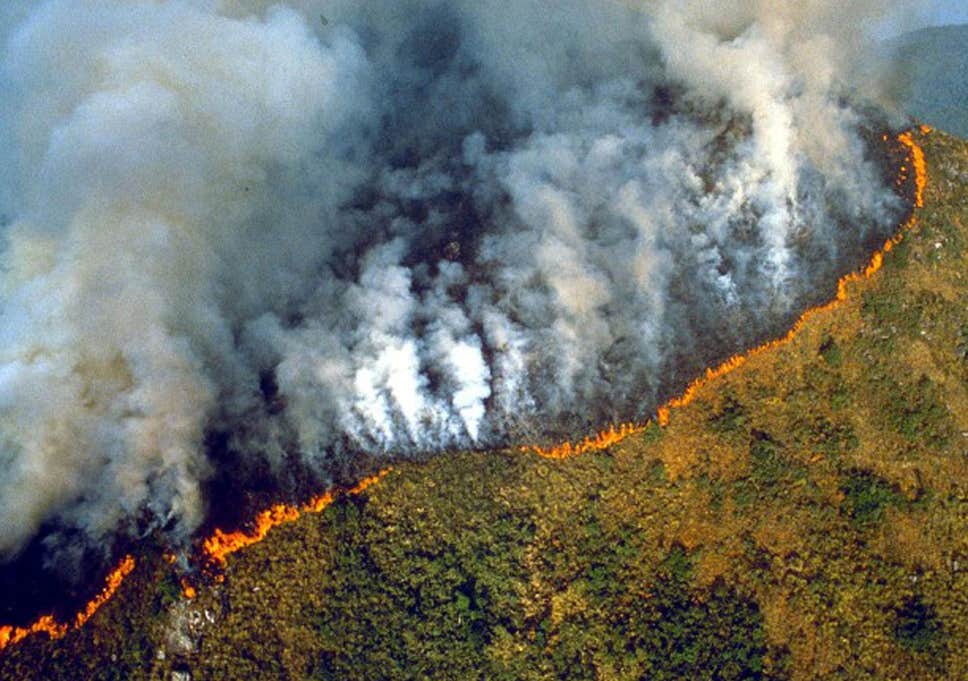
By: Catarina Araujo & Julia Osorio
Image Credit: https://noonecares.me/brazils-amazon-rainforest-is-burning-at-a-record-rate-and-the-devastation-can-be-seen-from-space/
Since the beginning of the year, the wood exploration and robbery in the indigenous park of xingu have significantly increased.
This year, the park marks its 60th year anniversary. The xingu community, gathers 16 different ethinicities, united by the similarity in their languages and principles. Hence, the park is divided in 3 different regions; Baixo Xingu, Medio Xingu and Alto Xingu. More than that, Xingu presents an enormous biodiversity in its 2.642.003 hectares.

Image Credits: Instituto Socioambiental/ISA, 2002
The native communities are completely dependent on natural resources. As nomads, the indigenous groups move from one area to another constructing temporary wood and straw houses. More than that, every food consumed and water is provided by the park’s natural resources. And that’s when the dangers of logging become evident.
For instance, the logging pollutes the water, causing a shortage in the fishing production in various communities. Considering that the fish are the most important food resource for indigenous communities, pollution becomes a significant problem.

Read more about the fish behavior in polluted waters

Dead fish due to pollution in the Corregos das Antas
Image Credits: https://portal6.com.br/2016/06/06/policia-civil-suspeita-que-despejo-de-esgoto-explica-morte-de-peixes-no-corrego-das-antas/
In the Amazon Forest, logging has been one of the region’s most productive economic activities. In order to legally cut trees from the forest, the environmental agency must provide a license for the producer. However, illegal logging activity has threatened the forest as the most important resource for indigenous groups is the nature itself that is devastated.
In 2022, the Xingu territory was the indigenous park that suffered the most forest fires. In the month of July, the number of forest fires in the Amazon forest increases due to the dry weather. Nonetheless, logging activity is a major contributor to the fires.
According to Luciana Gatti, the author of a study on the greenhouse effect, logging activity makes the Amazon forest lose its capacity to remove carbon from the atmosphere, which generates a series of feedbacks. According to the last report made by the Sistema de Estimativas de Emissões e Remoções de Gasses de Efeito Estufa (SEEG), the emission of gasses of the greenhouse effect has increased by 9.6% in 2019 compared to 2018 reports. From the gasses of carbon dioxide emitted, 28% come from agricultural production in the forest, 44% come from changes in the nature of the land and 5% from industrial processes.

Image Credits: https://www.socioambiental.org/en/noticias-socioambientais/rise-in-deforestation-and-fires-may-worsen-covid-19-crisis-in-the-xingu
Recently, the biggest issue on forest fires was the spread of Covid-19 in indigenous communities. With fires, the increase in air pollution will bring, as a result, more respiratory infections. Thus, putting a numerous group of people in a state of vulnerability in relation to the virus.
 EAC PRESS