
By: Sarah Valente
We recently came across some very sad news. This January Brasil broke the record for deforestation since the beginning of the monitoring in 2015.
Deforestation has been a problem in Brasil for many years now. On the 26th climate conference of the United Nations, COP26, which happened in November 2021, together with more than 100 countries, Brasil signed a deal for the protection of our world’s forests, which has the objective of completely ceasing deforestation by 2030.
How does Brasil monitor deforestation?
INPE, also known as the “Instituto Nacional de Pesquisas Espaciais”, emerged in the 1960s, motivated by the spacial conquers obtained by the Soviet Union and the United States at the time. According to INPE’s official website, their activities expanded a lot as time passed, and the importance of their studies now vary from complex subjects such as the origin of the universe to applications of sciences in issues like the deforestation of the Amazon. According to the article “Avaliação de dados dos Sistemas de Alerta da Amazônia: DETER e SAD”, published by “Anais XV Simpósio Brasileiro de Sensoriamento Remoto”, since 1998, INPE has carried out and published surveys and annual rates of deforestation in the Amazon. During this period of time, several detection systems were created for the monitoring of deforestation, such as PRODES (1998), DETER (2004), and finally DEGRAD (2007). Among these systems, there is also TerraClass which, in partnership with Embrapa, is utilized to map the use of the land after deforestation. Beyond the systems belonging to INPE, there is also “Sistema de Alerta ao Desmatamento” (SAD), made in parallel with the creation of DETER by the non-governmental organization IMAZON.
Deforestation in the last years
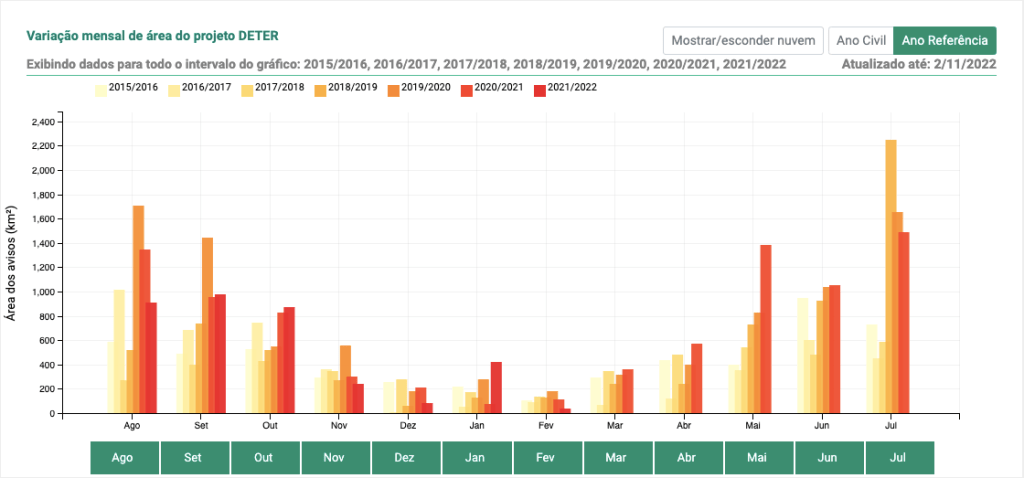
This is an analysis of data collected by the DETER detection system since 2015 in relation to deforestation in the Legal Amazon area:
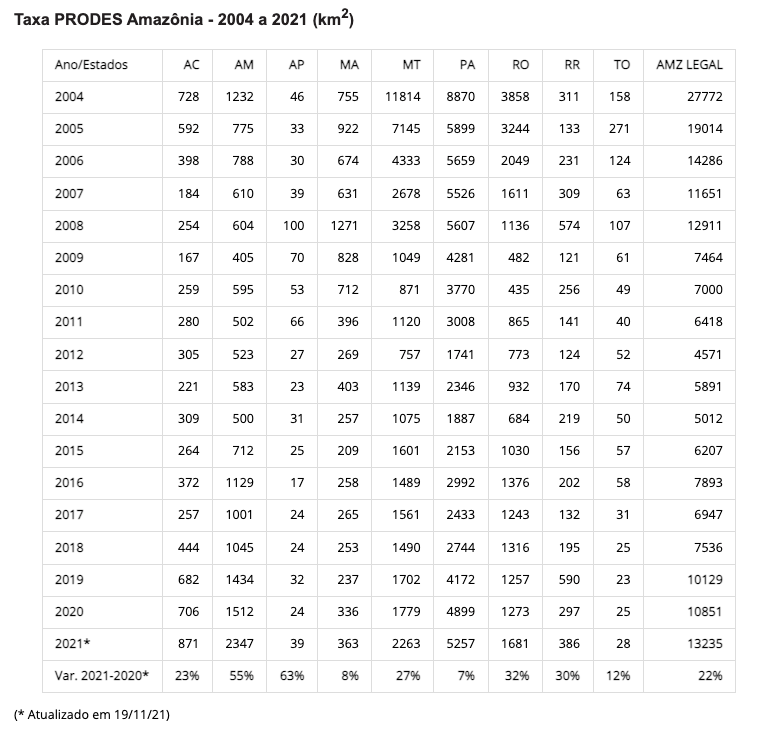
Monitoring of clear-cut deforestation by PRODES (2004 – 2021):
Last news about deforestation:
According to an article by G1, “deforestation alerts in the Legal Amazon in January were the highest recorded for the month since the beginning of the historical series, according to INPE data.” According to the DETER monitoring system, 360kmˆ2 were detected last month.
In the same article, the words of Claudio Angelo, communications coordinator for the Climate Observatory, are quoted in relation to the situation. He says, “If we are seeing such high deforestation in a month that is one of the rainiest and that, historically, has one of the lowest monthly averages of deforestation, because it rains all month, this is a very worrying sign”. In the same article, the words of Claudio Angelo, communications coordinator for the Climate Observatory, are quoted in relation to the situation. He says, “If we are seeing such high deforestation in a month that is one of the rainiest and that, historically, has one of the lowest monthly averages of deforestation, because it rains all month, this is a very worrying sign”.
It is important that we become increasingly aware of deforestation, especially now. The more people know about the reality of the current risk that our forests are at, the more chances we will have to save our Amazon.
Fontes:
http://marte.sid.inpe.br/col/dpi.inpe.br/marte/2011/06.27.16.55/doc/p1246.pdf
https://imazon.org.br/boletim-do-desmatamento-da-amazonia-legal-agosto-de-2015-sad/
http://www.inpe.br/faq/index.php?pai=1
http://terrabrasilis.dpi.inpe.br/app/dashboard/alerts/legal/amazon/aggregated/
https://g1.globo.com/natureza/noticia/2019/07/23/entenda-como-o-inpe-monitora-a-amazonia.ghtml
http://www.obt.inpe.br/OBT/assuntos/programas/amazonia/prodes
https://veja.abril.com.br/mundo/cop26-o-que-foi-alcancado-e-os-desafios-que-ainda-aguardam-solucao/
 EAC PRESS