

This is an interview made with Marta Bidoli, one of our school counselors, regarding college applications. As we enter high school and the year of our graduation gets closer and closer, a lot of doubts begin to appear in our minds. After all, how do you apply for college? What exactly is the PSAT? What is the difference between ENEM and vestibular? What do I need to do in order to apply for a college in Europe or even Asia? Having all of these questions is certainly overwhelming. The intention of the Answers project is to show that you are not alone, the help of our school counselors is always available. By making monthly interviews with our school counselors, which will be based on a few of your basic questions regarding college applications and study abroad, we hope to provide you with answers in a more practical way.
Interview
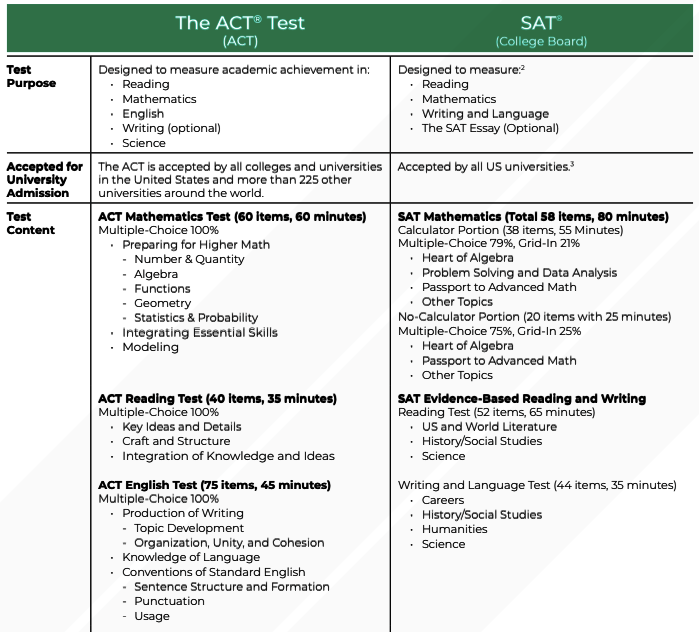
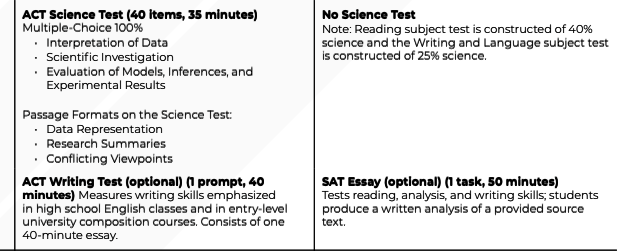
Question 1: What is the difference between the SAT and ACT? Is there a difference in content?
This table can help compare both tests and shows the main differences between them.
(Go to this site for the complete table)
Question 2: Between both tests, is there a best choice? For instance, if you choose one of them, is there a difference in opportunities?
There is no preference from universities – both tests are seen in the exact same way. The question of best choice is about what is best for the student. That might include understanding the style of the test, the pace, but also the logistics of taking it. Both the SAT and the ACT are offered in Brazil, however the SAT has more test centers because it is done on paper. The ACT is done on a computer at a test center, and the offer of dates and seats is more limited. We’d recommend taking a sample test of each to find out which one fits your skills best.
Question 3: We know there is a practice test for the SATs, also known as PSAT or Preliminary SAT. Is there a similar kind of preparatory test for the ACTs?
In junior year one of our goals as a school will be for all students that need to take one of these tests, will take them. That said, there are lots of resources available to study for all of these tests.
ACT Test Prep page – make sure you scroll down to free resources
AND we have many test prep books available for students in our counseling offices.
Question 4: How can you have access to the content that will be on these tests?
The content is listed on both the SAT and the ACT websites. Most of the content for Math, for instance, is covered in 10th grade at EAC. For this reason we recommend students test in 11th grade and not earlier.
Question 5: In general, which countries usually accept SAT and ACT?
The SAT and ACT are traditionally used for admissions to universities in the US. But there are two trends worth mentioning:
Some universities in Brazil have an admissions route using the SAT (Insper, FGV, IBMEC, just to name a few), as well as with IB score results (FGV, IBMEC, FAAP, Einstein). This is part of a trend of having multiple admissions routes to Brazilian universities.
In the US, there is an increasing number of universities becoming test optional, test blind or test flexible. This might be a short term policy change because of the decrease in access to testing world wide due to the global pandemic, or a long term commitment to reading applications without the need of having test scores. Fair Test is a website that compiles information about universities that have chosen to not require testing from students.
Question 6: Is there any advice you would like to give to the students who are preparing for either one of these tests?
I have two things to say about testing:
- Before thinking about testing and what universities want, start to think about what you as a student want and value in a university. Only when you understand what you want will you be able to find a university or college that is a good fit for you.
- Testing is only a part of the application process to universities. This should not be the central part of your preparation, nor should it be causing sleepless nights.
Question 7: What is the holistic review process?
Holistic review means, in essence, that the university is reviewing applications looking at the student as a whole. They want to understand, as much as they can, the entirety and complexity of the person that has just submitted an application. In this kind of review process, no part of the application is more important than others. Universities will be looking at the EAC transcript, predicted IB scores, and testing results (when needed) to understand how the student performs academically. They will be reading teacher and counselor recommendation letters in search of attributes and characteristics of each student. They will look at extracurricular activities, personal statements, and additional essays to understand students’ experiences, and most importantly, reflections around them. Which part is most important? Hard to say.
Question 8: At what qualities do colleges usually pay more attention to? For instance, if your grades are not as good, what can you add to your curriculum in order to compensate for that?
I can’t help but go back to the college list. The idea is that a student might apply to universities that fit their profile and where they might feel comfortable to learn and grow. If one part of your profile doesn’t exactly meet the criteria for one university that is an opportunity for reflection: is there a way and do I want to put in the time and effort to change? Do I value the same things as this university? If I enjoy hands-on work and the university values purely intellectual pursuits, is that a good fit for me? You should build your academics and activities around your interests and then find universities that will value them, not the other way around.
Suggest more topics!
I really hope this interview was helpful! If you wish to have more of your questions answered, please suggest more questions or topics that you think are important regarding college applications and study abroad. Remember that you can ask questions about college applications here in Brazil as well!
Thank you for reading : )
 EAC PRESS